
Back when I was first coming out, you were the one person to make a big deal out of insisting you already knew. I never bothered to question it; it implies you saw some sort of stereotypical behavior in me, but it also meant you had already accepted the idea. I got the opposite from most people; they never imagined this from me. I even had to insist to a few that I wasn’t just joking – I must have been the very model of a modern masculine heterosexual.
Hell, I think you even told my sister several years before I came out that you thought I was gay. Which, again, is a tiny bit rude; but you’ve always been a tiny bit rude. It’s part of your social charm.
Many years later, a group of us were standing in the kitchen at my parent’s house and you casually threw something else into the air. “You know, I’d describe you as agender. Something like David Bowie.” I’m not sure if you even know that agender is an actual term, but I certainly fit whatever you imagined it to mean.
Which, again; that’s kind of a rude thing to blurt out, especially with other family around. But, more than anything, I was disarmed. I had recently come across the concept myself, while searching to better understand who I was, how I fit in this world. I even thought of David Bowie as an inspiration, at least in his more flamboyant eras.
But I hadn’t told anyone – I hadn’t even fully accepted it myself yet. You spoke my identity into the world before I did, just casually as if you were simply stating a blatant fact.
How do you do this? With all the close, personal relationships I have had, how do you find it so easy to just look at me and know? Know before even I do?
When you referred to me as agender, I felt a strange mix of exposure and relief. Truthfully, it’s what pushed me into finally identifying as such. I needed to know someone else saw me this way, that it wasn’t all in my head.
So, it’s kind of sad that I still haven’t told you this truth of my identity – I haven’t really told anyone in the family. But I know, as soon as I do, you’ll probably say that same stupid thing. “I already knew.”
At a recent gathering, we somehow cycled back to how you thought I was gay so many years before anyone else. I was in a combative mood, so I challenged you. “So you think I fit a bunch of stereotypes, huh?” You were almost offended. I apparently didn’t match anything obvious.
So, what could it have been? “You never showed any interest in women.”
Well, huh. I guess that’s a reasonable explanation.
Month: January 2019
I Never Really Cared for You
We swung by your favorite chicken place as soon as you got back from the holidays. Despite the divorce, we still enjoy each other’s company; in the end, the issues of our relationship stemmed more from what we wanted than any problem with each other’s personality. We grew together, and unfortunately, sometimes growing together means growing apart.
You told me of various escapades that a more reasonable person probably wouldn’t tell their ex-partner, but I guess we’re just like that, before telling me that you paid a visit to your old neighbor. The one who essentially invited herself to our wedding and insists she’s a family friend, despite everyone in your family seeming more annoyed than anything else by her presence. I guess it’s because she’s a little old lady who was abandoned by her family, the type of thing that makes you feel sorry for someone – despite being fully aware of why her family might have been so vexed by her as to leave.
Apparently, she hates me now – no, wait. Apparently, she never really cared for me. Despite only meeting a few times and having me sit through her endless stories of whatever popped into her mind, I must have done something wrong. As you say, she only offers room to speak so she can find a new topic from the first words out of your mouth. People are but an audience to her, so I guess I must have been a poor crowd.
It’s funny, the way people think they can speak to you after a breakup. As if that person you once invested so much time in, got to the point of wanting to spend your life together with, was never that good. Is the sentiment supposed to be helpful? “You were wrong to care this much.”
It’s weird the things people assume. I’m sure these people don’t expect what they say to get back to me; could they even imagine you sharing these kinds of thoughts with me, despite everything? Are they aware that you told me because what they said hurt you? How can someone speak so casually and carelessly about a relationship they never saw the interior of?
Through everything, I still see you as a best friend. I know you need distance due to the divorce, but it’s clear you care too. And how could anyone suggest we shouldn’t care? Neither of us would be who we are today if we hadn’t met and fallen in love.
You deserve answers. I care too much about you. Even as our relationship fell apart, you still held something irreplaceable in me. You became like family.
So I guess it staggers me to realize how flimsy these relationships can be. Because, obviously, this old neighbor of yours means nothing to me. But, god, to think that people are angry at me because things simply didn’t work out between us, despite the two of us knowing better than that. Neither of us are really at fault here. These things happen all the time.
So what did all of this mean to everyone else? How quickly every other connection snapped as soon as things fell apart between us. Was it all an act? Did anyone ever really care? Or is accepting an outsider into your family always an act?
Is performative love inescapable?
We spent the first six years of our adult lives together. We’re never going to erase that and I don’t think either of us want to; I just wish other people could learn their place.
Remorse
How could I ever say I hate you? You showed me parts of myself I never would have discovered on my own. Despite our differences over the last year, the fact you want my friendship (unless I fucked it up that bad this time) means there’s something you see in me, something worth all the pain we sometimes cause each other.
I guess part of it is a fear for you, and the frustration that fear causes. The fact I know so much is going on beneath your surface, things I know you have yet to conquer. You want things to be simple, but how can this ever be simple for me, knowing what I know? Especially since in one of your rare moments of openness, you admitted to reflexively hiding things away?
I must have idealized the way you hid because I felt warmth in knowing I was one you found worthy of seeing the inner you. I was shown your interior, became a confidant of sorts. A person to turn to when troubled.
I can recover from a lack of physicality, or even real closeness. But what I’m struggling with is your performance. The fact I know everything you do is an act; the veil has been lifted. I can expect no sincerity from you, now that I’m no longer of romantic interest.
It is forbidden knowledge: once you know, you can’t unknow. You taught me to question your surface behavior, and I do; but now you leave me in the dark.
It’s not that I can’t accept reducing us to a simple friendship. It’s that a simple friendship is functionally impossible with what you’ve given me. You demand I play along, that I behave as if I never saw into your dark side.
But I don’t know how to play this game. I’ve never been good at hiding myself away.
But I can’t hate you, because I know enough to know where this behavior stems from. The walls you put up to survive with yourself. I pray I can learn to accept that you’re giving me what you can.
Indifference
A mutual friend of ours insists that the opposite of love isn’t hate but indifference, as to allow yourself to hate someone is to put them on a certain pedestal. They consume a part of your energy.
And, god, sometimes I wish I could indifference you. To wake up someday and simply not think of you, not unless you pop into my twitter feed or some other outside force. For you to stop inhabiting my space and become like the first ex, a shadow I can reflect on for think pieces and little more.
The energy I devote to the memory of us could be better used in so many other spaces. We want to be friends but friends don’t cause this kind of pain to each other. But I guess some people can work it out; but that requires, you know, working it out.
Sometimes I wish I could make like Jim Carrey and wipe myself clean of you; but I’ve been shaped too much by your presence. And the truth is that you’re not the one making me like this; I know the answers you don’t share. But I still care in a way you don’t, and that sometimes makes this idea of friendship seem impossible. You wound more than you soothe at times; every slight is amplified.
I rather quickly became bored of my first ex; why can’t you bore me? Why do I have to see you and have this faint hope that you’ll want to just chill sometime? That I could be your video game buddy you promised I would be in the months after the breakup. I can’t comprehend why simply chatting like we used to about movies seems so impossible. Why keep up this pretense of wanting to remain friends when you show no interest in what made us friends in the first place?
I made you angry a bit ago and it gave me this nauseating sense of pleasure; not that I hurt your feelings but that I mattered enough that what I said could still hurt you. I tried to apologize, but you instead went silent for several days. Once you got back to me, I realized I didn’t want to speak to you – perhaps the first time I felt that way since we met.
But of course I responded to you; not there, but here. To this feeling. God, I wish this feeling could last; that I could convince myself I never want to speak to you again, cut this all away and move on. To accept how much easier it would be to lock you away as a memory and nothing more. Or even just have the power to turn away when you speak.
But this is my angry place. In a week I’ll have turned. We’ll get back on track, whatever that track really is these days. Whatever wounds we have yet again inflicted upon each other will be swept beneath the rug until we again choose to do harm. With us, it’s so easy.
But right now, I’m allowing myself to hate you. To detest you with every fiber of my being. I want to watch you suffer, suffer until I again allow myself to feel pity, feel pity until I seek to comfort you, seek until you pull back again, feel you pull away until I want to watch you suffer. I want us trapped in this tormentous cycle eternally, reminding ourselves we could be around anyone else. You’re my personal hell right now, but maybe I can have the pleasure of being yours, too.
Because then I’d at least be something to you.
Spite
I was sitting at your kitchen table when you asked what I wanted to be when I was older. By that point, I had abandoned my dream of becoming a roller coaster designer, largely due to realizing my fear of heights meant I would never be able to enjoy my own creations. I had instead decided to settle on something I considered more reasonable.
“A writer,” I said.
“A writer? What are you going to write about?”
“I don’t know. I’ll figure it out.”
“All you do is sit around and play video games all day. What could you possible write about?”
It wasn’t just the way you tried to shoot down my wider dream. What really hurt was that revelation that you saw me as nothing more than a lazy child living in a world of fantasy, never engaging with the reality around me.
Did you ever really see me as a person? I didn’t know what I wanted to write about at that moment, but I knew I had to. If only to prove you wrong, I had to.
It’s never been some dream to become a famous author, no, I just have always felt the need to express something inside me. Even as a child I had already gone through so much; if you couldn’t see that, who would? I had to learn how to put into words what other people wouldn’t notice on the surface. How else would anyone see me as anything beyond some bored video game player?
So I guess that’s the true draw of this writing project for me. To write so much about solely myself, to prove to you that I am someone. That I have gone through so much that my life is an endless source of material, and you can never deny my personhood again.
And I wish you were still alive so I could shove this project into your stupid face.
Review: Mary Poppins Returns (2018)
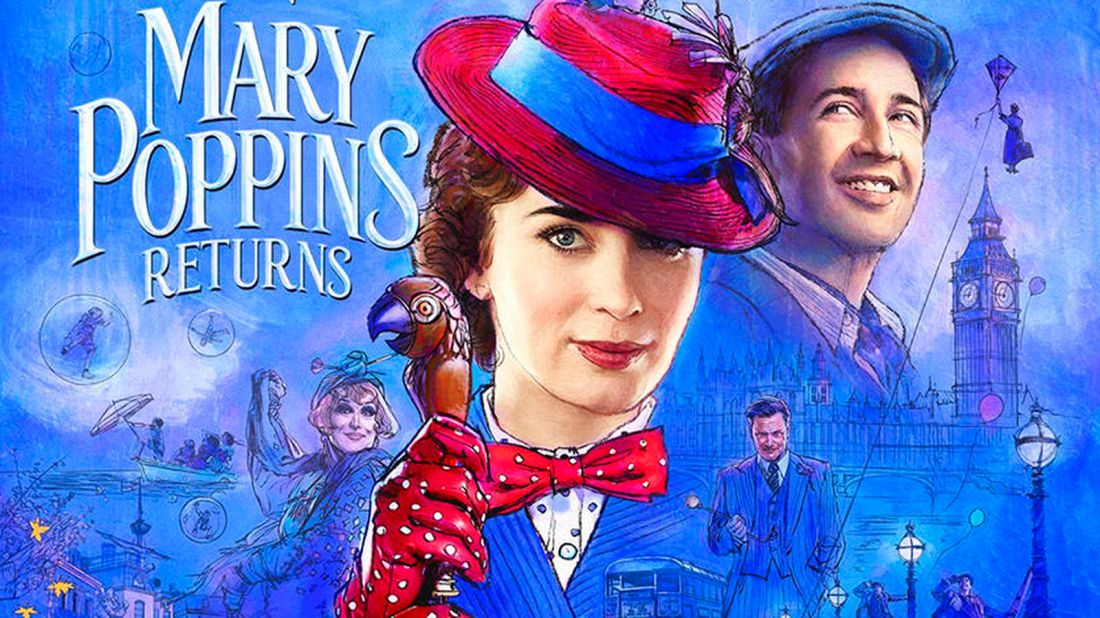
Mary Poppins Returns is one of several recent Disney nostalgia pieces; but instead of being an unnecessary live action remake of a classic animated film, it at least exists as a proper (if a bit too familiar) sequel.
So I guess I should be upfront about the fact that I honestly don’t care all that much about the original Mary Poppins. It’s a pleasant and charming experience, but it works like candy. Enjoyable in the moment, but little hangs around outside of a few classic musical numbers and Julie Andrews’ wonderful performance.
Mary Poppins Returns is a lot like that, but with less charm and artistry. It captures the general feeling of the original, but Disney seems all too aware that it didn’t have to do much to get an audience. Its pleasantness is purely mechanical; more than anything, this is the product of a mega-corporation that can’t be bothered to take risks. They know how to make a film work; but art should do more than just ‘work.’
How does Emily Blunt compare to Julie Andrews? That’s an unfair question to ask of most actresses; Blunt is going up against one of the all-time great performances. And, unfortunately, the film really doesn’t give her any moments to really shine. She does well enough, but there’s nothing particularly magical.
Which I feel is the perfect summary of the film itself; nothing particularly magical. The musical numbers are just fine; there’s no “Spoonful of Sugar” or “Supercalifragilisticexpialidocious” to get stuck in your head for the rest of time, nor any dance numbers as mesmerizing as “Step in Time.” In fact, just a day later, I can’t remember the sound of any of the musical numbers in this sequel. The scenes are pretty in their moment, but that’s all they really have to offer; momentary pleasure.
Mary Poppins Returns is a film with a key and necessary sense of visual design; but a lot of it is lost through rudimentary cinematic technique. The cinematography and editing are as simplistic as they come. So many of the scenes are simple waist-up shots of whoever is currently speaking, the film cutting back and forth between frantic conversations. There never seems to be any effort in framing the scenes; it’s a simple string of shot-reverse shot for many sequences, and a lot of slight adjustments that could have been avoided. Instead of guiding us, the camera and editing seems to be in a perpetual state of trying to keep up. These issues tend to (but don’t entirely) fade away during the musical numbers, which suggests that even the filmmakers don’t particularly care for the bits between.
There are moments where I’m not sure what Mary Poppins Returns is trying to say. The narrative relies too much on conveniences, and when nothing else comes along to solve the problem, it has a magical nanny who can step in and fix everything. An entire sequence at the end is almost completely negated by Mary’s intervention.
As pleasant and charming as it can be, Mary Poppins Returns never escapes from feeling like a product designed to be as safe and accessible as possible. Admittedly, in a world where family films can tend toward the grating and stale, it can be nice to have a work that is at least all around pleasant, and Mary Poppins Returns delivers there. But this film allows itself to be overshadowed by the original in pretty much every way. And in the same year as Paddington 2 and Spider-Man: Into the Spider-Verse, we know family films can do so much more than be pleasant.
3 Stars Out of 5
Review: Escape Room (2019)

Escape Room is an early January, PG-13 horror movie about a group of strangers trapped in a series of killer escape rooms; as such, you can’t go in with too many expectations, but it does a fair job of reaching those minimal hopes of at least being fun.
First things first, if you truly are itching for a good story about deadly escape rooms, go play the Zero Escape video game trilogy; though this may seem like a dumb premise, this is one that has actually been done incredibly well in a different medium – and considering the protagonist of this film starts off in a quantum physics class, I feel the writers have to be aware of this series. There’s no way to watch this movie and not compare the two.
As Zero Escape proves, the concept of Escape Room has room for excellence, but it requires a certain bit of cleverness the creators never strive to achieve. Actual escape rooms are full of twisted logic, and many times devolve into a room full of people yelling at each other in a panic as they become overwhelmed by puzzles. The most obvious way to translate this into horror is to make the solutions themselves dangerous; trying the wrong thing means risking death.
But here, the deaths are largely incidental. Of course the rooms themselves need to be dangerous to set the threat, but their true purpose should be to push the protagonists into doing something even more dangerous to escape. But there’s rarely a moment where anyone chooses to take a risk to proceed. There’s no satisfying ironies or conundrums here, just the basic struggle for survival.
The characters and dialogue are likewise shallow. Zoey is blandly quiet, Ben is a classical failure, Danny’s too oblivious to function, and on and on. A central premise is that these characters have all survived disasters in the past, but that seems to largely serve the purpose of trying to force our sympathies.
Escape Room also has a simply atrocious beginning and end. It opens with a character alone in a room, desperately trying to escape. It’s something we have come to expect from films like this, an earlier victim being shown meeting their gruesome fate – but this is no earlier victim. This is one of the main protagonists. They literally start the movie by showing that this particular character is going to be alone in one of the rooms, essentially spoiling the fates of everyone else. Additionally, the film introduces three of the characters before the game begins; it’s not hard to figure out why they get introductions and the others do not.
The last ten minutes exist purely to set up a sequel. There’s no satisfying conclusion here, just the bold promise for more. Due to this, Escape Room feels like part one of two.
While the story is flawed in numerous ways, I don’t find Escape Room entirely worthless. It’s tense where it needs to be, and the visual design of the rooms largely works. The upside-down room is an especially satisfying sequence. The technical and stylistic aspects are competent enough.
Escape Room works if you’re looking for some mindless entertainment; I never found myself bored outside of the overlong sequel setup. But it never aspires to anything more, and poor writing drags everything else down. It feels as if the creators thought the premise was clever enough on its own, without realizing the setups of the individual rooms would be the driving force of that cleverness; there’s no sense of effort. Instead, it’s Saw-lite, and who wants to be that?
1.5 Stars Out of 5
Exclusive Membership
You met your parents for lunch at McAlister’s soon after telling them of the divorce. You wish they could have treated it as a more solemn moment, but your mother instead dropped the idea of you paying for your own car insurance, because that’s what you needed to think about in the middle of mentally processing a divorce.
You helped catch them up on a few things. Since moving to the new house a few months earlier, you still hadn’t gotten around to replacing the garbage can your ex-husband accidentally thought you were leaving behind. The two of you made due with a smaller can for way too long. They offered to swing by a couple stores, see if you could find a new one. You remembered a Wal-Mart gift card your mother had given you around Christmas the year before, not as a gift but simply because she had it on hand and figured you could use it.
While fishing out the gift card, you decided to see what else might have been forgotten in the dark corners of your wallet. There was this strange blue card tucked away, solely marked with an “SW” on the front and a vague description of membership on the back. You pulled it out in confusion, having no recollection of what it could be. Your parents noticed your confusion and asked to see.
You handed it over, figuring it might not even be yours. SW? Sam’s Wub? What could it possibly be?
And then it hit you. Oh golly, did it hit you.
You ever so subtly asked for the card back. “I’ll figure it out,” you assured your parents as you swiftly hid it away. “Don’t even think about it.”
As you finished your meal, you couldn’t even make eye contact without having to hold back laughter. It was one of the most distinctly embarrassing moments of your life, despite the fact no one else was aware what had happened. Yet the more visibly embarrassed you got, the clearer it would become that something happened.
Thank god you managed to keep a relatively straight face.
As soon as lunch was over, you dashed outside. Looking back and catching your parents lagging behind, you tossed the card into the trash. You were straight blushing by the time your step-father was outside, but you wrote it off as remembering something funny. By that point, the membership card had likely been long forgotten on their part. You were free.
Next time, please don’t show off the membership card of the gay bathhouse you visited the previous summer during lunch with family. You’re lucky you got out of there with no one knowing what happened. It’s rare something so embarrassing can simply be walked off. Count yourself blessed that no one knows.
No one knows, right?
You’ve Got to Hide Your Love Away
Thanks to you, I’ve always been kind of afraid to tell someone I love them.
We were cuddling in your bed one day, and I shifted to lay on top of you. “I love the boyfriend,” you seemed to say, which was a weird way to say that for the first time, but I took it. I returned the words back to you, but in proper English and everything. I don’t think I really knew what love was back then, but it didn’t feel wrong to say.
A few weeks later you came to my house and immediately broke up with me. I was, of course, devastated. You had only just told me you loved me, and now you’re leaving. How could you go through such a change so suddenly, with no explanation?
We met up a few weeks later to talk about everything. You said you never loved me. I pointed out that you had said it first, and you said no. “All of the boyfriend.” Some stupid rage comic meme language, because that’s what you brought to the bedroom.
This is one of those things I wish I could look back on and laugh, because it really is quite dumb. But it just kind of hurts. I dunno, maybe it would sit with me better if we didn’t have sex between the confusion and the breakup. I could say it was all one big miscommunication and you realized this relationship didn’t mean as much to you, but I can’t. I felt used.
Even seven years later, having gone through a marriage and everything, I still doubt myself when someone says they love me. Maybe I’m mishearing, or maybe they realize they can get something from me if they say it. My first experience with being loved was a lie; not one you meant to say, but one you let me believe for far too long.
Despite their issues, I look back on my other two relationships with fondness. I had many more good times than bad with them. They ended, but a good relationship doesn’t have to be this eternal thing. I’m happy I had them in my life. I wish I could recall anything about our time together that I look at in a positive light, but this is the only thing I really remember. You made me feel weaker than I am.
Late Night Highway Sequence
I’ve always loved these kind of quiet memories, that type that really can’t have much meaning to anyone else.
One night, must have been back during winter break at the beginning of 2012, I had left your house after dark to drive back home to Decatur. I put on a mix CD of songs from the last year, songs I had discovered through a website that compiled critical music lists into one big master list. All of these songs were familiar to me to some degree, hence their appearance on my own burned disc, and they were intended as a simple comfort for those hour-long drives home.
But music has the tendency to evolve with certain experiences. On the dark of the highway, in a car with a proper bass system, “The Wilhelm Scream” by James Blake kicked on, and it’s like I had never truly experienced music before.
It’s a song I appreciated but felt I was missing something on – it was dense, ominous, something I had never heard before. It stood out, but I never knew what it meant. But that night, it came alive. It’s a song that works best while alone in the near dark.
“The Wilhelm Scream” is a solemn song, despite its title referencing a comedic bit of film lore. In the darkness of that night, it was like being lost in a sea of despair. The cascading energy of the ever-building music, matched by Blake’s anguished and soulful voice; the lyrics offered little beyond a short phrase with slight modifications, but Blake says so much purely through the atmosphere of the piece. It suggested a man losing sense of himself, increasingly overwhelmed, the music eventually drowning him out.
It was like finding the missing piece of a puzzle. Until that point, most of my music listening occurred through shoddy laptop speakers. Music was a new hobby of mine, and one I hadn’t yet realized could require a certain element, especially for certain bass-heavy songs like this one.
Ever since that day, I’ve always questioned my initial opinions on works. I’m not flawless; I could always miss something important. Of course I already appreciated “The Wilhelm Scream” enough to put it on a mix CD – but that night, it morphed into an all-time favorite.
Despite being a critical person, I rarely see the value in writing something off, especially if others seem to like it. I’d rather seek out understanding than dismiss something due to my own tastes. I’ve had countless Wilhelm moments since that night; clicking with Neil Young’s “Heart of Gold” after years of barely tolerating his voice, finally recognizing the value of Bruce Springsteen’s optimism in the face of despair, finding beauty in Joni Mitchell’s quiet works. I knew there had to be something there in all of these artists, and I was driven to understand.
In the end, I view art as a form of communication. While some can fail at getting across what they intend, there’s always the chance I’m not yet fluent in the same language – and I’ve always believed there’s something beautiful in putting in work to try and understand others.
 Fool Fantastic
You must be logged in to post a comment.