
My school district had a series of bomb threats back in the early 2000s. I was out sick when the one at my elementary school took place, and it turned out to be from a girl who thought she could get a few days off – third graders can be kind of stupid.
They were all essentially pranks, but they stemmed from a real fear – in that post-Columbine world, were we wrong to panic at the idea that one of these kids might be serious?
This was the same year as the attacks on September 11. I didn’t know what the World Trade Centers were – I didn’t even know what Muslims were. That whole section of the world was a vague concept, introduced to me through one violent day.
Mine was a childhood defined by paranoia – I’ve been anxious since those early days, but I’m certain this experience went beyond me. The early 2000s were a culture of fear.
I remember my mother picking me up, telling me how they got let out of work because her company could be a potential target. The following weeks, I was glued to the television set – which was a normal experience, except Spongebob was replaced by those two burning towers collapsing into dust.
In those following months, I learned of anthrax, snipers, the proper way to seal doors in case of gas attacks. There were weapons of mass destruction, terrorist cells, liquid bombs. None of this had happened in my town – yet. But the media wanted to make it clear that it could.
The news of the outside world can really creep into your private life – as a child, I had no clear idea of how to delineate why and where these things happened. But that box in my own living room kept saying the same thing over and over: be afraid, be afraid, be afraid…
Home was mostly safe. The only thing that could reach me there was one of those big bombs, but it’s not like anywhere outside would be safe from that either. There were tornadoes, sure – but it was somehow easier to accept that. Being in a town of 5,000 people located in the Midwest, they were certainly a bigger threat in my day-to-day life than anything man-made. Luckily, I had the news to keep me focused on the real danger.
So, there might be places to visit, people to see, but I’d much rather stay inside. You can’t make me leave. Everything I need is on the television set.
Life’s safer with the news turned on.
Month: February 2019
Review: Shoplifters (2018)

Shoplifters is only my third film from director Hirokazu Kore-eda, but based off of this in combination with Nobody Knows, I am convinced he has proven himself one of the most capable masters of tackling life in poverty.
A makeshift family comes together and navigates life; Osamu acts as the father of the family, teaching young Shota how to shoplift. The wife Nobuyo works with laundry, stealing whatever trinkets she can find forgotten in pockets. Elderly Hatsue acts as the matriarch, collecting pensions and running scams, while Aki works at a hostess club. One day, as Osamu and Shota return home, they come across a neglected young girl and end up bringing her into their family, rescuing her from abuse but legally kidnapping her.
Kore-eda balances this tale in such a way that we are fully engaged with their struggle to survive while keeping us at enough distance to question who these people are. Their connections are blurred, to the audience and even each other. They operate as a family, living together and having each other’s backs, but they rarely allow the others into their internal struggles. Kore-eda knows to let questions linger, adding an air of mystery to an otherwise straightforward tale.
The subject matter feels like the perfect topic for a slow cinema film, and it carries the painterly aesthetic of that movement, but Shoplifters is anything but slow. All six members have their own poignant tales, bringing life into each scene. This is not a tale of people wallowing in misery, but rather finding beauty in the most surprising places.
The central theme of Shoplifters is the concept of what makes a family. Is it simply biological, or does it really consist of the people who care for you? This question appears to have its most obvious answer in the little girl, Yuri, who finds safety in this new home. But Kore-eda knows it’s not that simple – as Osamu and Nobuyo observe, they feel like broken people, and what do they truly have to offer? They give love and their own warped sense of care, but they can’t offer a brighter future or security.
Shoplifters exists in a similar visual realm to Ozu films; the central focus is framing. Kore-eda perfectly considers the boundary of the image, where each object is placed, crafting a vibrant visual landscape even in desperate settings. A particularly standout sequence finds Aki performing at work; the way her schoolgirl outfit clashes with the usual imagery, the patron writing on a white board to communicate as he sits obscured in near-total darkness on the other side of glass, the surprisingly touching moment they share as they go back for a direct session. Every shot carries obvious consideration.
That brief moment between Aki and her guest perfectly captures the heart of the film – as broken as people can feel they are, there’s something magnificent about how they can come together, understand one another. Certain directors make similar films and get derided for making ‘poverty porn,’ as if they are simply exploiting the poor for the entertainment of the better off. But there’s no sense of exploitation here – this is an honest tale of fully-realized characters, as true-to-life as it can be. This is not a study of poverty but a celebration of life itself told through the eyes of some of its most vulnerable people.
Works as compellingly mundane as Shoplifters are a rare treat. Kore-eda never comes off as simply trying to spread a message; this film is a consideration. He wants us to ponder our own connections, how we view the world. Whenever an easy answer seems to bubble up, Kore-eda squashes it back down, culminating in a harrowing finale. Kore-eda never offers us answers, but rather gives us questions we rarely think to ask.
4.5 Stars Out of 5
Review: They Shall Not Grow Old (2018)
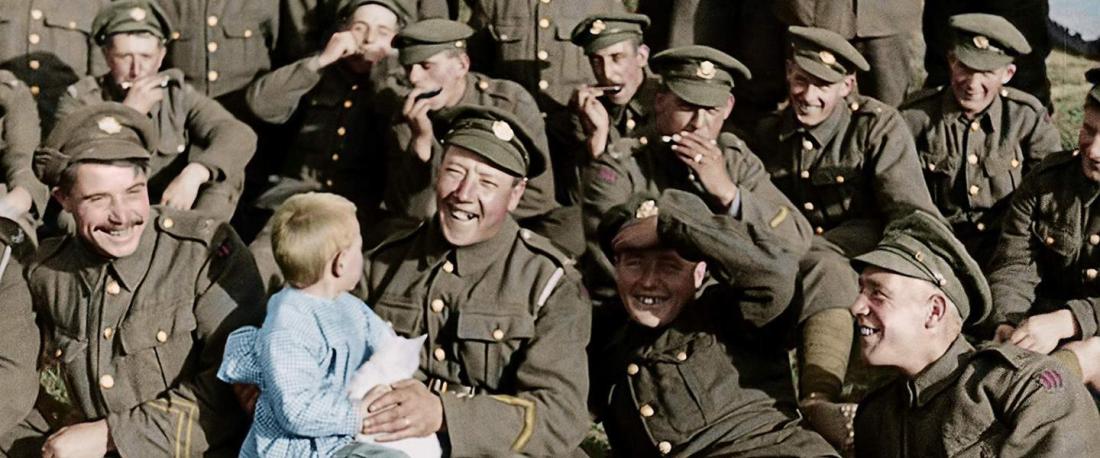
Peter Jackson has put together a World War I documentary consisting purely of archival footage and other media from the era, reconstructed and colorized with modern film technology. It is both a testament to what can be done in the name of film preservation (and beyond) and a richly visceral dive into the Great War.
They Shall Not Grow Old is a sensory experience; it doesn’t cover new ground as much as it attempts to make you feel. In a way, it is a fantasy upon itself – so much is crafted through guesswork. Improvements upon the clarity of the image are always welcome, and I feel like that’s the place a lot of preservationists would stop. Peter Jackson goes several steps further – adding color, mixing in imagined sound. It creates a more immediate resonance, but also adds a layer of artifice – the addition of people voicing the soldiers in the footage felt especially jarring to me.
The most effective moments of the film come from a more simple element; it’s the way in which Jackson mixes the footage with post-war interviews. Soldiers recount tales of their experience, Jackson jumping between unrelated interviews until he crafts a more general view of the war experience – this is a glimpse of the war from the ground level, the daily lives of those who fought in it. The overall narrative design is sometimes simplistic but always carries such incredible force.
Even with the rather wide scope of the film, the best moments come down to specificity. A rather gross yet memorable sequence discusses the lack of toilets and the simplistic systems used in their place – one soldier recounts a time where a group of soldiers fell off the pole they were sitting on into the pit below. A more disturbing moment comes not from the combat directly but the state of the trenches – a soldier describes watching a young man slowly drown in the mud, no one really able to reach out and help.
They Shall Not Grow Old exists in this weird state of contradiction. As a documentary it seeks to expose the truth, but then it modifies the truth it has to be more presentable to a modern audience. It is likewise composed of individual memories, strung together until the voices of these individual soldiers become lost in the crowd – in a way, this film shares a lot with the collectivist storytelling of early Soviet cinema.
The question I keep returning to is, what is the purpose? Is it simply to give World War I a wider reach? It’s certainly a harrowing topic, but even with all the modernized footage, it’s the voices of the soldiers that leave the most impact. Were their words not enough to convey the horror?
They Shall Not Grow Old is an impressive technical feat, a journey into how far cinematic technology has come – but it also comes off more as a document than a great work of art. Pieces that already existed are cast in a new light; its mere existence has value, but it is also limited by its goal. The version I saw had an introduction by Peter Jackson, where he discusses being approached for the project; a hundred years later, what new meaning could be brought out of this old footage?
I don’t think anything particularly new was found – however, Jackson has constructed the perfect entry point for people unfamiliar with the war, the type of film I can see serving an honorable purpose in classrooms across the world. With the materials provided and the intended goal of the project, I can’t imagine anyone doing a better job than Jackson did here.
4 Stars Out of 5
A Hopeful Wedding
I don’t want us to look back and say this was all for nothing. We carried each other through our first years away from our family, and nothing was telling us these feelings would fade. Could anyone blame us for getting married after five years together? It seemed right.
We can listen to “Ladies and Gentlemen We Are Floating in Space” and feel sad for what is no longer there – but it was there. We have those memories, we can know that there is someone out there who really got us better than anyone else, and knowing that means knowing there are other people out there, too. There is love in us. We shouldn’t be ashamed because we got so close that we imagined devoting our entire lives to each other. That closeness is such a beautiful thing, even if it didn’t last as long as we had hoped.
I guess the concept of marriage is tainted for us now. How will either of us learn to trust again? No, how can I ever trust myself to know what I really want? I was so sure of this, but I was the one to ask for the end. I don’t want to hurt anyone else – I’m damaged goods.
But, no, I’m capable of more. I can rebuild myself, and you can, too. We don’t know how to move forward, but we are moving forward. Every new day we reconstruct ourselves further. We can choose to be ashamed of that label, of being ‘divorced,’ but it’s a sign that we once allowed ourselves to love someone fully. There’s nothing wrong with having been young and in love – this can be such a lonely world, and you gave me freedom from that feeling for so long.
Even as we soon part ways, you going off to either claim your PhD or moving back in with your family for a bit, me staying behind in this same college town, a part of you will remain within me for life. I assure you, there’s no replacing what we had together – but new towers will dot our skylines.
 Fool Fantastic