
It’s odd how much something as small as a Facebook update can leave a lasting impact.
I can’t remember the context, or even which of us made it. All I know is one of us mentioned board games, the other commented, and you eventually convinced me to go to Techfront. Neither of us are even sure how we were already friends on Facebook at that point.
The Technological Frontier Society – a former futurist society that eventually grew bored of discussing futurism and eventually devolved into a sci-fi club. By the time I joined, it was a standard midnight movie club with board games inexplicably thrown in.
Six and a half years have passed since that first trip, yet I spent my most recent Saturday evening at that club. I even graduated four years ago, yet I somehow find myself tied to it.
With how central it has been to me, it’s weird how out of place I felt there in those early months. I’ve always been intimidated by new people, and most of the people there already had their distinct groups. I felt as an outsider.
You were my in, the one person I could comfortably speak to before I eventually broke in with the others. If I had simply stumbled across this club on my own, I can’t imagine I would have stayed long. It’s easier to hermit.
My freshman friends quickly faded, so I’m always surprised to look back and see how long this group has lasted – we had a table at our wedding that was essentially the Techfront crowd.
Your perception of people tends to change as you get to know them, yet you summarized yourself so perfectly early on. You gave me a ride to Techfront from our dorm one evening and talked of your website. You claim to have a literal pun addiction and created a place to express those humorous yet invasive thoughts – an addiction so strong I believe it’s referenced on your license plate. After talking this site up, you suddenly warned me never to visit.
“Are the puns that bad?” I asked innocently enough, as if I expected you to have shame.
No, no. The site had been hacked and taken over by spam bots. You saved me from a potential virus, but the awful puns? Those would be the cost of your friendship.
Month: March 2019
Review: Fighting With My Family (2019)

Family, identity, and dreams serve as the central theme of this WWE biopic. Paige and her brother Zak have been raised in a wrestling family, and the two gain a rare chance to try out for the WWE. Paige gets in – Zak does not. As Paige becomes overwhelmed with this new world, Zak appears to be falling down a similar path as his older brother, who ended up in prison after failing at this same goal.
There’s not much to this as a work of cinema – this is the standard modern Hollywood-style biopic. It finds a strong central story with a heartfelt message, competent but not pushing any technical boundaries. The camera is here simply to tell the story and nothing more.
A film with such basic features is going to be limited in its impact, having to be carried almost entirely on the back of its narrative. Luckily, I feel confident in saying that this does have a fairly effective story – despite having next to no interest in wrestling as entertainment, I found myself caught up in the emotions. It finds universal sticking points in its tale of underdogs and ‘failure.’
The other key element of the standard biopic is acting; the central actors here all fit well in their roles, though no one gives anything particularly award-worthy. This film runs on familial interactions, and they do well enough while playing against each other – it’s just hard to do much with such a familiar narrative.
I feel like I keep highlighting the cliches – but I don’t think they’re all that distracting. Despite its simplicity, I truly was engrossed by what was happening. A bitter ring fight between Zak and Paige as she briefly returns home really highlights the wedge driven between them by her success. There’s this constant return to coping – how do you manage dreams that you have been raised on when bluntly told you won’t be allowed in?
There’s a similar focus on who belongs where – we are in on Paige’s side from the beginning, but she is treated as an outcast. We are initially taught to look down on her fellow competitors due to their origins; models, cheerleaders, women who look pretty in the outfit but have never stepped in the ring before. After all, few women are actually raised wrestling. But this underdog story takes a deeper look – Paige is called out for her condescending attitude. She learns nothing of these women, but they all have their own story to tell. In fact, Paige truly appears to be the underdog in every sense, even falling behind on physical training. The film never takes the easy path, insisting on painting everyone in a sympathetic light – in the end, everyone feels like the underdog until they succeed.
Despite being as basic as films come, Fighting With My Family is an entirely competent work with an engaging narrative. While its central focus is on a violent sport, it comes off as an entirely well-meaning and optimistic work. Not everyone will be successful in achieving their dreams – but there is more to life than dreams.
3.5 Stars Out of 5
Review: The Wandering Earth (2019)
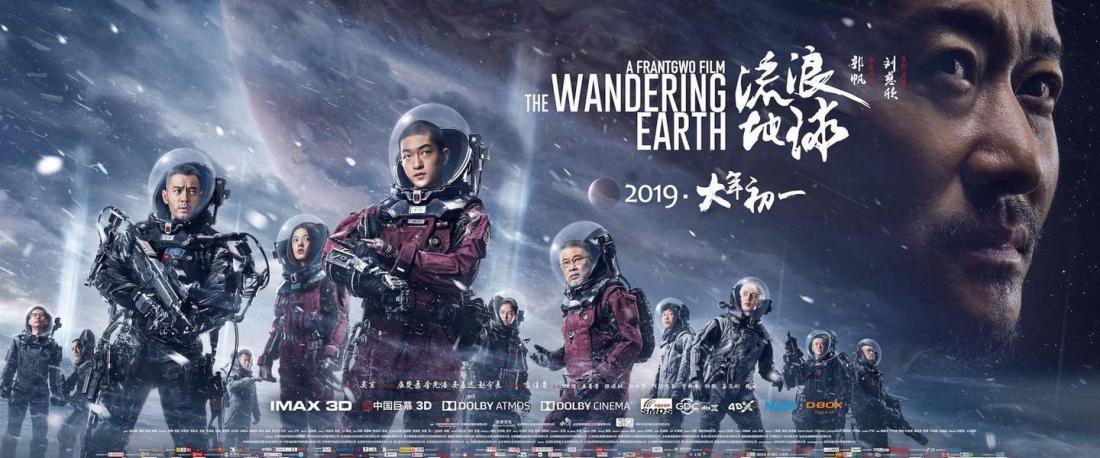
Wandering Earth is currently the best-selling movie of 2019 – but you probably haven’t heard of it. The box office intake is almost entirely centralized to China itself – but due to the size of that market alone, it has become the second-most successful foreign language film of all time. Wandering Earth is part of an increasingly successful, yet self-contained, mainstream Chinese cinema.
This is noted as the first successful Chinese sci-fi blockbuster – but that doesn’t really mean much for artistic value. This film runs off pure, dumb energy like any other generic sci-fi spectacle piece – it simply happens to be Chinese this time.
Wandering Earth is absurd in its scope. The sun is beginning to enter the red giant phase, and our collective solution is to attach thrusters and push the entire planet somewhere else. Along the way, we attempt to use Jupiter’s gravitational pull to slingshot us through space, but there’s naturally a miscalculation that puts the planet on a direct trajectory into disintegrative doom.
In other words, this leans more on the fiction than the science.
The film bounces between two locations. Astronaut Liu Peiqiang is aboard a space station that guides the planet, soon finding himself in combination 2001–Gravity land as he must dodge space debris and confront a killer A.I. Meanwhile, his family on Earth gets caught up in a rescue mission, which falls hard into the epic disaster genre, specifically recalling The Day After Tomorrow with its frozen metropolises. These bits are all painfully familiar, and I can’t decide whether it’s more rip-off or an attempt at pastiche for China’s first project of this scale.
Despite its rather lacking scientific basis, Wandering Earth sure enjoys spending a lot of time trying to make sense of everything. Like Alita, this is a film that gets sidetracked explaining concepts that really don’t matter for its purpose. There are a few cool moments that would hopefully balance things out, but where Alita has a director who at least understands raw action spectacle, there’s not enough here. The only truly stand-out imagery from this film comes in the form of shots of Earth as it is pushed through space by its thousands of blue jets, leaving a trail in its wake.
The central concept is too nonsensical to really drive itself, and the characters are also lacking. Liu Peiqiang and his son Liu Qi have been separated for seventeen years, and their drive to reunite seems to serve as a central personal conflict. Qi is angry for a variety of reasons, but it all seems so shallow when the world itself is on the verge of evaporation. Qi has his grandfather and an adoptive sister along for the ride, but neither offer much besides familial relations – an idea that frequently pops up throughout the film as government propaganda encourages people to spend their last moments alive with their loved ones.
They are surrounded by characters who don’t do much but die – I get the feeling they were going for the group protagonist angle as typical of films from countries that try to push communist themes, but it makes for a rather bland cinematic experience. The one side character who stands out in any meaningful way is Tim, an Australian-Chinese man who serves as comic relief…who is implied to be a rapist. For comedic purposes.
If you’ve been eagerly awaiting the day where even more countries push out works like 2012 and The Day After Tomorrow, then Wandering Earth must be an exciting prospect. But all this really represents is a country with a big enough economy and population that it can create its own insular Hollywood – it will take a certain amount of time before they can push out a truly unique and international success. It’s a Hollywood disaster flick with a Chinese flavor – there might be some cultural differences in its message, but it’s not competent enough to really be saying much at all.
2 Stars Out of 5
 Fool Fantastic