
You took over as the second president of my time at Techfront, though you seem to have been running it from the shadows for a while before, the figurative and sometimes literal showrunner.
The previous president was your typical straight white nerd, alarmingly conservative considering the people he surrounded himself with. Yet our choice of subject matters became increasingly, subtly queer under his rule.
I remember when you came out; it was the day after you hosted a Techfront at your apartment over the summer – or could it have been a winter? All I remember is you tended to host over breaks. For whatever reason I felt guilty about misgendering you the night before, even though I obviously didn’t know until the following day. I had met plenty of transgender people by that point, but you were the first who I saw go through the coming out process.
I don’t think I began questioning myself until watching you navigate this territory. Despite my previous encounters, the idea of being transgender felt like this distant thing until that weekend.
We collectively jokes about there being a radical queer agenda taking over Techfront – but it wasn’t really a joke. It was an active effort on the part of several members. So many of us had tried out other nerdy clubs on campus and found ourselves out of place among largely straight and unfortunately unwashed men (though a few of our members were admittedly lacking in hygiene as well…). There were plenty of queer clubs on campus, but they carried it as a focus that similarly rubbed many of us the wrong way. We wanted a halfway point – a place to just chill on the weekend while carrying an actively accepting atmosphere.
So I joined Techfront when it was a general nerdy Saturday evening affair, but it’s your influence that really made Techfront what it is in my mind. It was so relieving to have a place that was queer but not about being queer.
Author: foolfantastic
Mr. Pun
It’s odd how much something as small as a Facebook update can leave a lasting impact.
I can’t remember the context, or even which of us made it. All I know is one of us mentioned board games, the other commented, and you eventually convinced me to go to Techfront. Neither of us are even sure how we were already friends on Facebook at that point.
The Technological Frontier Society – a former futurist society that eventually grew bored of discussing futurism and eventually devolved into a sci-fi club. By the time I joined, it was a standard midnight movie club with board games inexplicably thrown in.
Six and a half years have passed since that first trip, yet I spent my most recent Saturday evening at that club. I even graduated four years ago, yet I somehow find myself tied to it.
With how central it has been to me, it’s weird how out of place I felt there in those early months. I’ve always been intimidated by new people, and most of the people there already had their distinct groups. I felt as an outsider.
You were my in, the one person I could comfortably speak to before I eventually broke in with the others. If I had simply stumbled across this club on my own, I can’t imagine I would have stayed long. It’s easier to hermit.
My freshman friends quickly faded, so I’m always surprised to look back and see how long this group has lasted – we had a table at our wedding that was essentially the Techfront crowd.
Your perception of people tends to change as you get to know them, yet you summarized yourself so perfectly early on. You gave me a ride to Techfront from our dorm one evening and talked of your website. You claim to have a literal pun addiction and created a place to express those humorous yet invasive thoughts – an addiction so strong I believe it’s referenced on your license plate. After talking this site up, you suddenly warned me never to visit.
“Are the puns that bad?” I asked innocently enough, as if I expected you to have shame.
No, no. The site had been hacked and taken over by spam bots. You saved me from a potential virus, but the awful puns? Those would be the cost of your friendship.
Review: Fighting With My Family (2019)

Family, identity, and dreams serve as the central theme of this WWE biopic. Paige and her brother Zak have been raised in a wrestling family, and the two gain a rare chance to try out for the WWE. Paige gets in – Zak does not. As Paige becomes overwhelmed with this new world, Zak appears to be falling down a similar path as his older brother, who ended up in prison after failing at this same goal.
There’s not much to this as a work of cinema – this is the standard modern Hollywood-style biopic. It finds a strong central story with a heartfelt message, competent but not pushing any technical boundaries. The camera is here simply to tell the story and nothing more.
A film with such basic features is going to be limited in its impact, having to be carried almost entirely on the back of its narrative. Luckily, I feel confident in saying that this does have a fairly effective story – despite having next to no interest in wrestling as entertainment, I found myself caught up in the emotions. It finds universal sticking points in its tale of underdogs and ‘failure.’
The other key element of the standard biopic is acting; the central actors here all fit well in their roles, though no one gives anything particularly award-worthy. This film runs on familial interactions, and they do well enough while playing against each other – it’s just hard to do much with such a familiar narrative.
I feel like I keep highlighting the cliches – but I don’t think they’re all that distracting. Despite its simplicity, I truly was engrossed by what was happening. A bitter ring fight between Zak and Paige as she briefly returns home really highlights the wedge driven between them by her success. There’s this constant return to coping – how do you manage dreams that you have been raised on when bluntly told you won’t be allowed in?
There’s a similar focus on who belongs where – we are in on Paige’s side from the beginning, but she is treated as an outcast. We are initially taught to look down on her fellow competitors due to their origins; models, cheerleaders, women who look pretty in the outfit but have never stepped in the ring before. After all, few women are actually raised wrestling. But this underdog story takes a deeper look – Paige is called out for her condescending attitude. She learns nothing of these women, but they all have their own story to tell. In fact, Paige truly appears to be the underdog in every sense, even falling behind on physical training. The film never takes the easy path, insisting on painting everyone in a sympathetic light – in the end, everyone feels like the underdog until they succeed.
Despite being as basic as films come, Fighting With My Family is an entirely competent work with an engaging narrative. While its central focus is on a violent sport, it comes off as an entirely well-meaning and optimistic work. Not everyone will be successful in achieving their dreams – but there is more to life than dreams.
3.5 Stars Out of 5
Review: The Wandering Earth (2019)
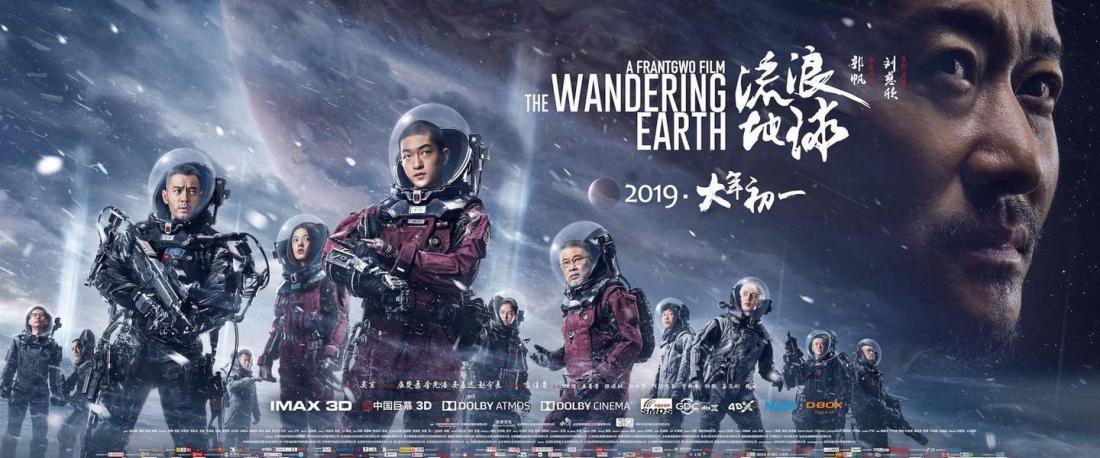
Wandering Earth is currently the best-selling movie of 2019 – but you probably haven’t heard of it. The box office intake is almost entirely centralized to China itself – but due to the size of that market alone, it has become the second-most successful foreign language film of all time. Wandering Earth is part of an increasingly successful, yet self-contained, mainstream Chinese cinema.
This is noted as the first successful Chinese sci-fi blockbuster – but that doesn’t really mean much for artistic value. This film runs off pure, dumb energy like any other generic sci-fi spectacle piece – it simply happens to be Chinese this time.
Wandering Earth is absurd in its scope. The sun is beginning to enter the red giant phase, and our collective solution is to attach thrusters and push the entire planet somewhere else. Along the way, we attempt to use Jupiter’s gravitational pull to slingshot us through space, but there’s naturally a miscalculation that puts the planet on a direct trajectory into disintegrative doom.
In other words, this leans more on the fiction than the science.
The film bounces between two locations. Astronaut Liu Peiqiang is aboard a space station that guides the planet, soon finding himself in combination 2001–Gravity land as he must dodge space debris and confront a killer A.I. Meanwhile, his family on Earth gets caught up in a rescue mission, which falls hard into the epic disaster genre, specifically recalling The Day After Tomorrow with its frozen metropolises. These bits are all painfully familiar, and I can’t decide whether it’s more rip-off or an attempt at pastiche for China’s first project of this scale.
Despite its rather lacking scientific basis, Wandering Earth sure enjoys spending a lot of time trying to make sense of everything. Like Alita, this is a film that gets sidetracked explaining concepts that really don’t matter for its purpose. There are a few cool moments that would hopefully balance things out, but where Alita has a director who at least understands raw action spectacle, there’s not enough here. The only truly stand-out imagery from this film comes in the form of shots of Earth as it is pushed through space by its thousands of blue jets, leaving a trail in its wake.
The central concept is too nonsensical to really drive itself, and the characters are also lacking. Liu Peiqiang and his son Liu Qi have been separated for seventeen years, and their drive to reunite seems to serve as a central personal conflict. Qi is angry for a variety of reasons, but it all seems so shallow when the world itself is on the verge of evaporation. Qi has his grandfather and an adoptive sister along for the ride, but neither offer much besides familial relations – an idea that frequently pops up throughout the film as government propaganda encourages people to spend their last moments alive with their loved ones.
They are surrounded by characters who don’t do much but die – I get the feeling they were going for the group protagonist angle as typical of films from countries that try to push communist themes, but it makes for a rather bland cinematic experience. The one side character who stands out in any meaningful way is Tim, an Australian-Chinese man who serves as comic relief…who is implied to be a rapist. For comedic purposes.
If you’ve been eagerly awaiting the day where even more countries push out works like 2012 and The Day After Tomorrow, then Wandering Earth must be an exciting prospect. But all this really represents is a country with a big enough economy and population that it can create its own insular Hollywood – it will take a certain amount of time before they can push out a truly unique and international success. It’s a Hollywood disaster flick with a Chinese flavor – there might be some cultural differences in its message, but it’s not competent enough to really be saying much at all.
2 Stars Out of 5
Review: Cold War (2018)

Pawel Pawlikowski’s Cold War is a study of life in post-war Poland, following two lovers who would never fit in among the communist society that formed. This is romance at its extremes, two self-destructive people trapped inside a brutal machine.
Cold War runs largely off the vibrancy of its characters. The story starts with Wiktor Warski recruiting peasants for a folk music project. He becomes immediately enamored with Zula, a beautiful young woman who begins by attempting to ride the coattails of a more vocally-talented woman and is soon exposed as a city girl. Despite this, Wiktor casts her and they begin an increasingly desperate love affair.
The narrative structure is straightforward, its cruelty all the more palpable due to the simplicity. There’s so much at play here – two artists restricted in their freedom to create, but increasingly difficult to cheer on as more inner flaws are exposed. Cold War plays with our ability to sympathize.
What really sells Cold War as an important film is its stunning black and white cinematography, framed in a square ratio as if to announce that this is indeed an art film. Each image feels as if it could have fallen out of some old photo album. Pawlikowski has a tendency to allow his central images to sit just off-center, drawing our attention to the full picture. He’s dedicated to a conspicuous lack of symmetry.
There’s something disconcertingly fatalistic about the film, which holds a certain power but might not have landed with me as intended. Perhaps I lack the cynicism to be snared by its message – Cold War hits like the bleakest kind of Bergman movie. But walking disasters like these characters certainly exist – this is a film that seems to lack personal resonance despite carrying all the signifiers of a great work of art.
But with a title like Cold War, I suspect that feeling is intentional. The concept of giving up on everything but a single person should leave us cold. They are relatable and not – I’m sure many people have experienced a love that might have bordered on obsession at some point, but to carry it as far as Wiktor and Zula is madness.
Cold War is undeniably a well-crafted film. The actors, the cinematography, the staging, the sound – from a formalistic perspective, this is easily one of the most impressive films of 2018. It never wastes time, saying so much in less than 90 minutes. Its design is purely mechanical – cold.
But I’m wrong to suggest this movie is entirely cold – it’s filled with the fire of passion. In fact, I think contradictions are a key element of this film. People madly in love go out of their way to harm each other while beautiful camerawork lingers on dirty scenes – this is love framed against rubble. Perhaps this is less about love and more about trying to find something, anything to be passionate about in a world where expression is limited and constantly surveyed.
To put it plainly, I walked away from Cold War not knowing what to make of it – though its narrative was succinct, the meaning behind it is layered. These are the films that carry a lasting impact, and I’m certain this will be a work I look back on in a year with a stronger perspective. I’m already eager to revisit it, which is a rare state for me. But at this current moment, I can only say it’s a beautiful film that didn’t resonate quite enough to hit me now.
4 Stars Out of 5
Review: How to Train Your Dragon: The Hidden World (2019)

The third film in the How to Train Your Dragon franchise, The Hidden World captures a lot of what made the first two movies the best animated films out of Dreamworks this decade. But is retreading the same ground enough to make this a good film in its own right?
My praise for The Hidden World would be very similar to that of the previous films – firstly, the animation is phenomenal. The series pushes more realistic character designs while maintaining a cartoonish charm, avoiding the uncanny and offering dozens of stunning sights. Each character has their own distinct design, yet they fit perfectly side by side. The Hidden World‘s greatest strength over its predecessors is five years of visual evolution.
What’s always striking about this series (and DeBlois’s earlier Lilo and Stitch) is how it manages to capture character among non-human figures – a ton of effort is poured into getting Toothless’s animations just right, giving him perhaps the most vibrancy of any character despite an inability to speak.
A central focus of this movie is Toothless meeting a female member of his species that the humans nickname Light Fury. A great scene on the beach finds Toothless attempting to woo her, invoking childish moves and odd Birds of Paradise-inspired dances. These details establish Toothless as an awkward young adult much like Hiccup.
Which, the relationship between Hiccup and Toothless is the guiding force of the series – and I’d say this is where The Hidden World falters a bit. The film does reach similar emotional heights to the first two entries, but a lot is saved for the ending.
Where the first two films speak of learning the language of a supposed enemy and coexistence, The Hidden World deals with separation. Hiccup and Toothless have formed an almost symbiotic relationship over the series, but The Hidden World gives Toothless his own personal pursuits. While this provides a strong inner conflict for Hiccup, it disrupts the screen time between the leads.
Where The Hidden World is a largely satisfying conclusion to a trilogy, its central conflict doesn’t do enough do raise the stakes from the previous. The villain is largely forgettable and is notably less threatening, and most of the characters lack an arc or real development – despite the distinct designs, the side characters offer little but comic relief. This is an excuse to revisit the familiar more than being an expansion on the lore.
Luckily, this is a world worth revisiting. For those invested in the series, it will hit you hard at key moments. Despite being about mythical creatures, How to Train Your Dragon has always felt like the story of a boy and his dog. The Hidden World pushes past that, instead paralleling old friends who you know someday will go their own way. Toothless is never subservient but an equal, and this entry explores what that means as the two enter maturity.
As such, The Hidden World is a stellar conclusion to a great series, but one that doesn’t quite have as much impact on its own. The narrative beats land a bit flat during the second act, but this is balanced out with quieter stakes from the earlier installments. How much you get from this depends entirely on how invested you are in the series as a whole.
3.5 Stars Out of 5
Why We Build the Wall
I entered the 2016 election with much the same feeling as the 2012 election – there’s no way we would actually vote in Donald Trump of all people, right? A man I and likely most of my generation knew through reality TV, who we had previously collectively laughed at for his orange complexion and awful hair, who made George W. Bush look intelligent and grounded?
But I made sure to vote anyway – unlike Romney, Trump felt like a true threat. Even if the polls suggested he had little chance of winning, and again my vote in Illinois would mean nothing either way, politics no longer stood in the background. More than likely, I was galvanized by the 2014 election – my first job out of college was represented by a public union, and we were essentially public enemy #1 in Bruce Rauner’s Illinois. I couldn’t vote him out until 2018, but I had learned other races matter.
Trump winning is still this surreal moment – just like my high school, I somehow believed we as a country had moved past such blatant displays of hatred. But an entire swath of our country voted in a man who spoke to nothing but underlying fears of the other. How can so many people – the people who by all measures have the power in our country – be living lives guided by terror?
You invited me back to your office that next morning – you could recognize my despair, knowing that I was young, openly gay, and therefore more than likely sharing your political leaning. You told me we’d get through it. I was terrified – I was in the midst of planning my wedding, and had only just gained that right. How much could Trump and a Republican Congress take from us?
You spoke of how we survived Bush and survived Reagan – but did we? Did people like me truly ‘survive’ Reagan? White women like you, yes. But nearly an entire generation of gay men were wiped out by a virus that Reagan actively ignored.
Not only was I gay, but I was finally coming to terms with the fact that I probably didn’t identify as a man. I didn’t identify as a woman, either, so I wouldn’t really be affected by these bathroom debates, but where would the line stop? Most people don’t accept that non-binary people like me even exist – I had every right to believe Trump and his Congress would attempt to delegitimize us further, not just socially but through legislation.
People like me, we’re simply one of the many building blocks for the wall. Trump knows he can call upon us to strike up new fears – that his wall won’t be built until his followers are convinced they’re being attacked from every angle. These people are blinded to the actual sources of the instability in their lives, living as though they’re dying of a preventable disease and happy with articles that claim the blood they cough will go away once they spit enough out.
So, yes – you will survive. As much as you didn’t want it, Trump’s America is designed to harm people like you the least – and I can count myself lucky I’m still high enough on the pecking order that I probably will, too.
R-Money
You were pissed at me for not bothering to vote.
I tried to talk it down – after all, this was Illinois. Obama couldn’t lose here, and if he somehow did, we certainly weren’t going to be the swing state.
I came into that night with relatively little fear – who in the world liked Mitt Romney? You pointed to other things, such as local elections. I’m afraid to admit I’ve always been a bit more ignorant than I like to admit. None of it mattered – things would work out fine.
I feel like I can better recognize your frustration now – me, a white (at-the-time-identifying-as) man, telling a black woman there was nothing I was afraid of. I carried the privilege of not having to care. You appealed to my queer identity, but the polls were already closed. There was nothing we could change at that point.
We sat around watching the numbers come in, but I was quickly bored as the predictable result occurred. This election carried as little meaning to me as that mock election back in 2000; the safe, familiar thing was happening, and my side was winning. It would have been nice to see Democrats regain power in Congress – but it’s not like I really appreciated anything beside the presidency even at the beginning of my adulthood.
Man – it was really nice not having to care.
Hope
It’s not the glee at finally being rid of Bush or anyone like him that I remember about the day after the election, nor was it celebrating that the same America who elected George W. Bush twice was now welcoming its first black president.
No, what I sadly recall is overhearing an upperclassman talk about wanting to take his father’s shotgun to the White House as we sat in our computer class. The murmurs in the hallway featuring words I would never repeat here, in a town I never realized was like this.
I remember sitting beside you as you spoke of lynching before Pre-Calculus began. I had known you for several years at that point, and I was unaware something so vile sat inside your heart. That not only did you carry so much hatred toward those of differing beliefs, but that it was expressed through a desire for racial violence – all of this coming from one of the most bullied girls in our school.
To think I used to pity you.
I had been ignorant enough to believe this type of vitriol was limited to the south – that everyone was equally shocked back when our eighth grade history teacher spoke of the time her grandmother casually mentioned baking for her father’s Klan meetings over dinner. Soon after the election, another history teacher who had a particular focus on the Civil Rights movement informed us that even our own town of Mt. Zion had a history with lynching.
His name was Samuel Bush, and he was accused of assaulting a white Mt. Zion woman and taken to the jail over in Decatur. The Deputy Sheriff and Chief of Police tried to talk down the mob of nearly one thousand people that had gathered, an act for which the latter was assaulted. Sam Bush was dragged naked through the streets, offered a last word as a noose was already so tight around his neck that it had to be loosened for him to speak. “I hope to see you again in heaven,” he told the crowd of people gathered to murder him.
Our town is the type of place where you imagine the same families hanging around for well over a century; was your great-great-grandfather one of the men who gathered to hang Samuel Bush at the corner of Wood and Water? Which, now that I’m looking at a map of Decatur, I realize is a corner right outside the building where my step-father and aunt work.
I never realized this was so close to home.
Mt. Zion was so white-washed that I never really had to think about race until Obama became president. I assumed everyone had accepted the whole ‘racism is bad’ thing – the worst I thought was maybe some misguided beliefs through our lack of really experiencing diversity. But to you and your kind, Obama was a very real threat.
A bit later, that same teacher brought in a cousin of Emmett Till as a speaker. He told our school of that horrid night, of being there at one of the most nauseating atrocities in American history. I’d like to think this got through to people like you, that hearing a first-hand account of such horror would wake you up.
But more than likely, his story fell on deaf ears.
Critical Failures
Even as a child, I never understood how George W. Bush won a second term. Perhaps the explanation was as simple as my likely reason for going against Gore, that John Kerry was so frightfully boring that Bush managed to come off as the more charismatic of the two.
Whatever the case, it became so hard to believe in this country. How could it come down to those two choices, how could we choose the same person who dragged us into such horrifying conflicts with no apparent end? Bush fumbled everything he touched, and his nonsense vocabulary was by this point familiar. If this man represented the country as a whole, it was scary to think what this country was.
But at the end of the day, this was a minor annoyance in my daily life. It didn’t affect me directly in any meaningful way, and Bush being president was a familiar experience. Surviving another four years would be easy enough.
And if nothing else, I never got the sense Bush was intentionally trying to sabotage our country – the lack of intent behind harm somehow seems honorable these days.
 Fool Fantastic
You must be logged in to post a comment.