Review: Aquaman (2018)

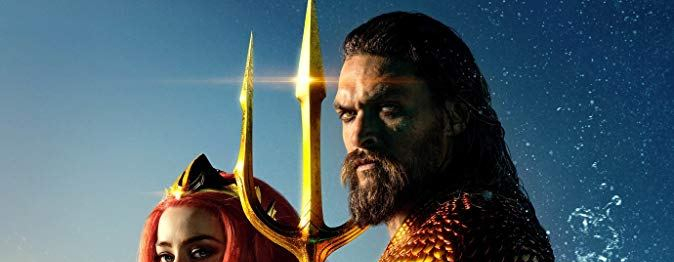
Aquaman might be on the upper end of the DC universe, but that really isn’t saying much at all. A bloated, meandering narrative that doesn’t do anything particularly well, the film is an easy skip.

My recurring thought throughout the film was, how could anyone think Aquaman demands the same running time as Mulholland Drive? What depth could there be to explore? Turns out, not much. It feels as if the movie is padded out, which is usually something people do when they’re struggling to meet a minimum.

Aquaman does a phenomenal job revealing everything it’s going to be doing wrong in its opening act. We begin with Aquaman’s parents meeting, because this is an origin story that apparently requires us sitting through the birth of the hero. You see, Aquaman is the child of both land and sea, a fact the film will remind you of in what feels like every scene. But, just in case you won’t figure that fact out through dialogue, the filmmakers delay the actual plot so they can show you that, yes, Aquaman really is half-Atlantean.

This opening is followed by a scene of young Aquaman being bullied while casually talking to fish in an aquarium. Which, yeah, you look kind of dumb, kid. He’s clearly old enough at this point to realize no one else does anything like this.

The movie sends a shark to his defense, banging against the glass until it cracks. But even with this dangerous creature, there’s nothing quite as nonthreatening as fish at an aquarium lining up in Aquaman’s defense, safely on the other side of some glass. Do you really want to start a superhero flick by drawing attention to how very specific and in most cases useless the hero’s powers are?

In addition to simply being a dumb scene, it’s entirely unnecessary. The rest of the film takes place twenty years later; if we don’t already know what Aquaman’s powers are going in, it’s soon going to be shoved in our faces. Why waste so much precious time here?

When we finally get to adult Aquaman finally doing his thing, he’s just kind of there. He beats the crap out of some pirates, not saying much of anything and giving awkward mugs to the camera when things go his way. He’s simply ‘generic superhero stand-in #33.’ He’s just doing something heroic, with no context to why he’s doing it or even who he is; we know his backstory, but we don’t really know him, and we don’t really gain any meaningful knowledge about him during this sequence.

Making this moment worse is the introduction of one of the future supervillains of the work. He’s a pirate working alongside his father! And his father has this hamfisted speech about a knife that belonged to the grandfather that he’s now giving to his son! So of course the father’s going to die and the son is going to swear revenge. In addition to being the most generic supervillain archetype, this plot point really goes nowhere during the film. His entire character arc could have been cut without changing much if anything about the narrative; whatever he actually needs to do for the plot to get going could just as easily have been background information.

The movie continues into adventure territory, with some semblance of an actual narrative finally popping in after Aquaman drags its feet for the first half hour, but there’s not any particular moment that feels worth mentioning.

Even on a visual level, which is usually of some appeal in even the most generic superhero films, Aquaman largely fails. The costume design is laughable, so many close-up shots look like the actor is simply inserted over a backdrop, and most of the action sequences aren’t very compelling due to the film having to balance fighting with swimming.

Ultimately, Aquaman is simply subpar at pretty much everything it attempts, made worse by dragging itself out endlessly. The only thing that makes it a better than average DC film is that it doesn’t have a lore we collectively care about enough that it can desecrate.

2 out of 5 Stars

Review: Roma (2018)

After crafting two of the greatest sci-fi films of the 21st century in Children of Men and Gravity, along with giving us the best Harry Potter film, Alfonso Cuarón returns with a work reminiscent of his breakthrough, Y Tu Mamá También.

Roma is the story of Cleo, a poor maid working for an upper class family in early 70’s Mexico City. While the film stays focused on Cleo’s journey over the course of a year, it uses her tale to explore so much more.

Like Y Tu Mamá También before it, Roma is set against a backdrop of political upheaval. And much like the protagonists of that earlier work, Cleo herself never becomes particularly involved; these events exist as a looming threat, one most would rather ignore until it physically comes to them. So, while this story is about Cleo (and hers truly is a phenomenal tale – the final act of this film is both devastating and revelatory), Roma is just as much a story of the city itself.

This is accomplished through Cuarón’s stellar cinematography. Nearly every shot runs for an extended length, usually set in an incredible deep focus. Many scenes find several elements battling for attention; for example, an early scene finds Cleo with a man at the theater as a comedic war film plays in the background. The relative motion draws your eyes to the film, despite knowing the true action of the scene is the conversation in the foreground. Even in all these wide shots, Cuarón is expertly in control of where eyes will land.

In many ways, Roma is a slow film – but I would say that is ultimately to the film’s benefit in the long run. Minutes can go by without much happening, and I found myself questioning just what this movie was about during its opening hour – but so much is subtly put into place through these moments. The opening hour is like a lift hill, a necessity before we rush into the inevitable. It’s easy to be an hour in and come to the conclusion that this is an ‘art film’ to an annoying extreme; by trying to be about everything, it appears to really be saying nothing at all.

But by setting us up to believe that this is a film of vague intentions, Cuarón manages to catch us with no expectations of where it will truly land. Despite its relative visual distance from its human characters, this film truly is concerned with the human experience. This is a rare film where I had to let the credits run through, so in shock at my feelings that I had to take several minutes of silence to recuperate.

There is a key image Cuarón returns to throughout the film. The first time it happens, the father of the family returns early; Cuarón cuts between various shots of the car pulling into the drive, avoiding the father himself until he finishes pulling in. The excruciating detail of this scene is how clearly the car does not fit in the narrow drive. We return to this same scenario, the car both causing damage and becoming damaged itself. Both for the characters and the audience, there is a desire for something bigger, some grandiose meaning to everything. But sometimes, too big is too much. Cuarón is aware of his excess from the beginning, and it’s when the mother of the family returns with a smaller vehicle that the plot is also allowed to narrow. Cuarón knows when to go big, but he is always in command.

Roma is the best film by one of the greatest directors working today. It is a pure visual feast, clearly inspired by Fellini’s most excessive works but never losing its humanity. But where Cuarón really outshines Fellini is his treatment of women; Roma is ultimately a tale of womanhood, of the expectations thrust upon women by society and the harsh methods of coping that are sometimes necessary.

Roma is about women, about Mexico City, about political revolutions, abandonment, despair. Roma is one of many art films that strives to be about everything all at once; but it’s a rare one that largely succeeds at the endeavor.

5 stars

Review: Spider-Man: Into the Spider-Verse (2018)

Spider-Man: Into the Spider-Verse towers over every superhero film since The Dark Knight, outpacing the Marvel Cinematic Universe by never fearing to experiment.

Into the Spider-Verse is practically a necessity at this point, after three other distinct Spider-Man film franchises have been thrust upon us this century. As much as it tells the story of Miles Morales (originating in Marvel’s Ultimate Spider-Man comics) and his familiar tale of adapting to newfound powers in the wake of a multiverse-shattering cataclysm, the story is just as much a commentary on how and why we revisit the same stories over and over with slight variations. This is a film that pushes artistic boundaries while reveling in the familiar, a flawless reminder that a great work is not in the originality of its material but the fresh new ways that story is told.

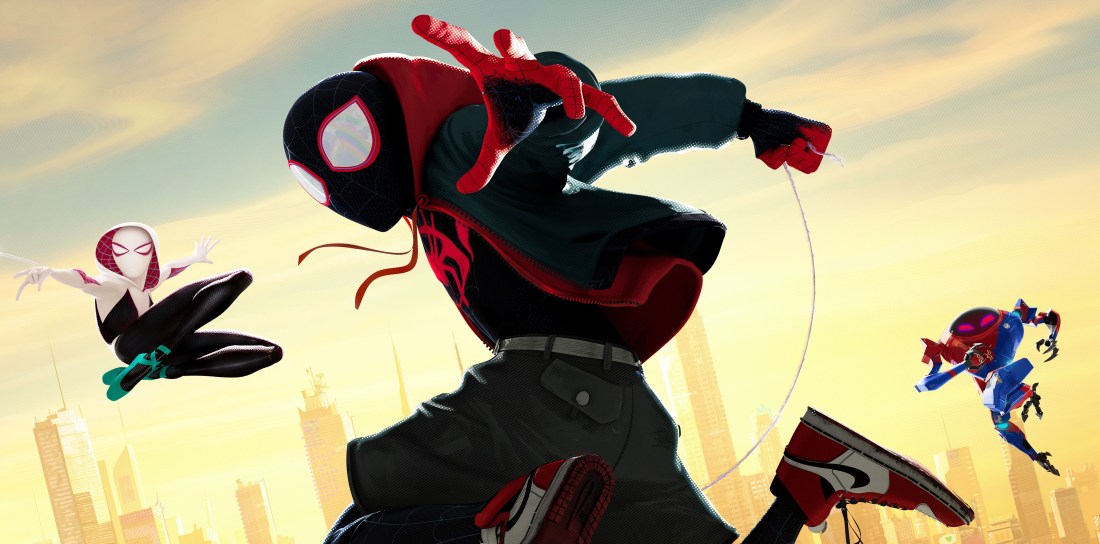
More than being a great superhero film, this is a phenomenal comic book film; which is to say, this is a film that goes to great lengths to simulate the way in which a comic book looks and reads. Purely on a visual level, this movie captures the style of a comic, from elements as subtle as framing to the blatantly obvious use of action words popping on screen. Into the Spider-Verse unabashedly evokes its source material.

The most key element in translating this language from comics to cinema is the film’s rapid editing style. Each shot feels structured like a panel, establishing a singular point before cutting to another angle, another concept. Due to this structure, Into the Spider-Verse never loses a sense of rhythm during its two hour running time. There is a poignant brevity to its presentation.

At the heart of this all is a rather simple plot. We follow Miles Morales, a kid who lives in a city that already has its own Spider-Man. Miles is distinctly not Peter Parker, of both African American and Puerto Rican descent, with two loving and living parents and an uncle that encourages his more mischievous side. Following the comic run he originates from, Miles must soon pick up the mantle of Spider-Man after the sudden death of his world’s Peter Parker.

Miles soon finds himself among five other Spider-Man equivalents from alternate realities, from a slightly different Peter Parker to a Gwen Stacy who took on the mantle of Spider-Woman in a world where Peter Parker turned to villainy. The film focuses on both their distinctions and the familiarity of their plot beats. Though they are their own characters, the ultimate lore of Spider-Man shines through. Bitten by radioactive spiders, becoming heroes, and ultimately losing someone very dear near the onset of their journey (an effectively blunt use of foreshadowing considering Miles has yet to experience this loss). Though they have only just met, there’s a distinct sense of unity among these Spider-people. There is comfort in the familiar.

But what ultimately pushes this film into the upper tier of superhero films is not its narrative elements, but the rather extreme stylistic shifts it performs throughout. This playfulness is at its most obvious with the three other Spider-people, all of which draw attention to the absurd degree the Spider-Man myth has been spread. From the anime-inspired Peni Parker and her mecha-spider friend, to the funny animal Peter Porker and the self-describing Spider-Man Noir, Into the Spider-Verse pays homage to earlier works that pushed the basic Spider-Man structure to its extremes.

Their presence lends the perfect excuse for the film to sacrifice typical visual cohesion, allowing the film to sprawl out in whichever direction it feels best suits any individual moment. The final act is a descent into absolute psychedelia, a pure visual feast. It is a rare gift to have a film that goes this far out of its way to embrace style over realism. Into the Spider-Verse joins the ranks of films like Hausu and Scott Pilgrim as examples of just how unrelentingly stylish a film can be without losing track of its purpose or audience.

Spider-Man: Into the Spider-Verse is a testament to the concept of style as substance. There’s nothing shallow in its appeal to visual pleasure; it is rooted in several distinct eras and movements, evoking concepts with the right use of color here, a distinct sense of framing there. Like any good adaptation, this is a work that simultaneously admires its origins while striving to communicate its purpose in a distinctly different medium. It’s not just an adaptation but a translation. This is assuredly the Spider-Man we collectively know and love, but in a way we’ve never seen before.

5 Stars