The Greatest Games: Final Fantasy VI (1994)

Final Fantasy VI (1994)
Developed by Square

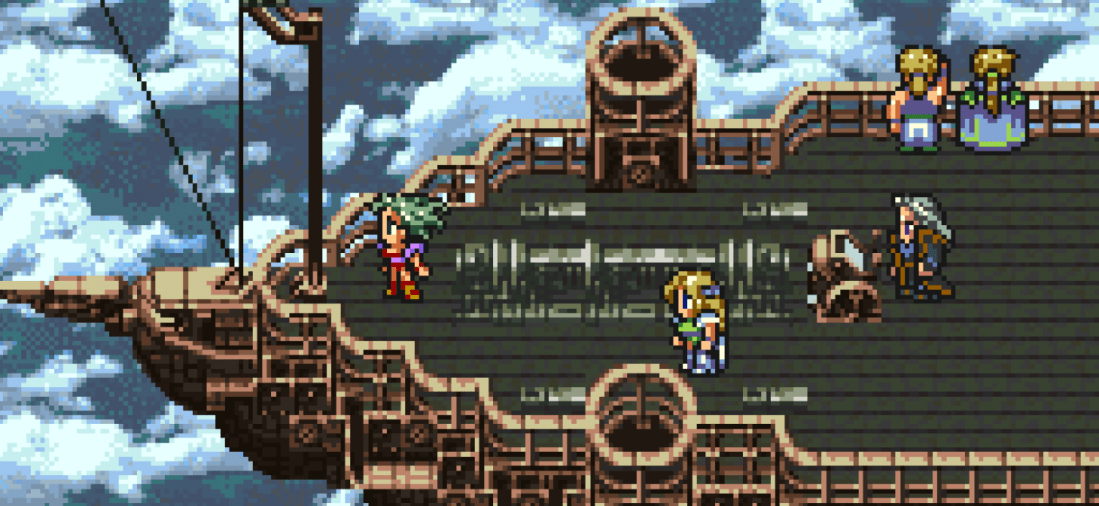
While IV and V are truly great in their own right, VI is when the Final Fantasy series started churning out downright masterpieces year after year. VI builds upon IV’s narrative foundation (V still stands as a distinct entry), telling the story of a bunch of plucky adventurers as they fight to save their world. Where IV was always centralized around Cecil and most of its revolving cast consisted of temporary characters, VI does away with a protagonist entirely.

Some will argue that Terra or Celes are the ‘true’ main character. This doesn’t really matter. Significant is the fact that this structure allows the game to constantly split the party while never relegating any party member to a minor role. This culminates in a final dungeon where the player must split their 14 party members into three teams of four. Many JRPGs have giant casts, but few utilize them all in such a meaningful way.

This split structure also helps highlight each member of this colorful cast. While the quality isn’t exactly consistent, characters like the Figaro brothers, Terra, Celes, Shadow, and Locke all rank among the best in the series. Then there is the first unforgettable villain in the series, dancing mad court mage Kefka Palazzo. His colorful outfit hides a ruthless sadist who only wants to see the world destroyed. The game doesn’t even treat him as a serious threat initially. His cackling soundbite is spine-tingling, and he’s one of the few convincing displays of destructive nihilism. There’s no cheap stab at creating sympathy – Kefka is a living embodiment of evil, plain and simple. The heroes absolutely have to stop him.

And what makes Final Fantasy VI so effective is that they don’t. Not initially. The game is divided into two distinct halves. The opening is rather straightforward beyond its branching paths, but the second half turns closer to an open world experience as Celes finds herself in a shattered world. All of the heroes have been split up, and the team must reunite to have a chance at getting their revenge on Kefka. This atmospheric shift was key in establishing FF6 as having one of the first truly great video game narratives, and it also gave the player a chance to have their own sense of control as they sought out the remaining heroes.

With its fourteen party members, FF6 stands out by giving each of them a clearly defined function through a special command. Sabin pulls off awesome physical feats which must be input like a traditional fighting game. Gau imitates enemies through his rage ability. Edgar utilizes special tools with a variety of effects. Each and every character fills a niche. Meanwhile, the esper system gives the player a bit of control over how the characters level and gain magic.

Most modern JRPGs have Final Fantasy IV to thank for establishing solid narratives in traditional video games. Final Fantasy VI refined these elements. From a strong cast to a surprisingly dark narrative to a large world to a phenomenal soundtrack by Nobuo Uematsu, this is everything you could ever want from a Final Fantasy experience, years before VII finally set the world on fire.

The Greatest Games: The World Ends With You (2008)

The World Ends With You (2008)
Developed by Square Enix and Jupiter

Nintendo has not released a traditional console or handheld system since 2001. Dual screens, motion controls, autostereoscopy, a handheld-console hybrid; there’s always some gimmick. This would be great if so many of these concepts did not end up overlooked outside of a few key first party games. Those later gimmicks have moved toward changing the console experience rather than offering a new gameplay potential, as if Nintendo has accepted this underutilization.

The true selling point of the original Nintendo DS was the implementation of a touch screen, which predates the popularity of touchscreen-based smartphones by a few years. The dual screen aspect was often implemented as a convenience. Some games used the screen for a map, while others used it for menu navigation. Most developers seemed wary of forcing the player to engage with both screens simultaneously.

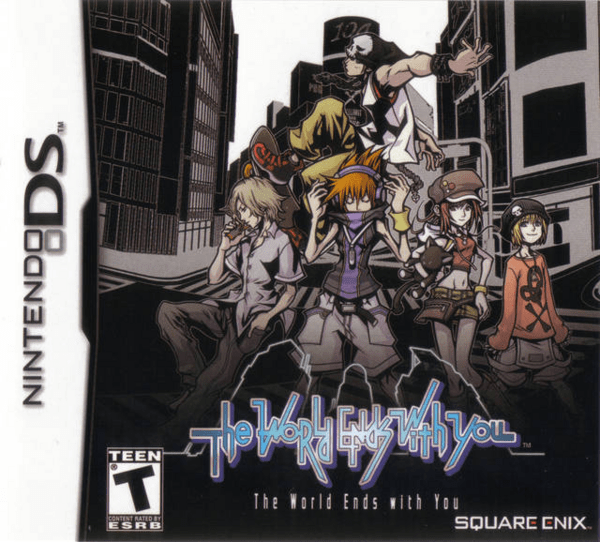
By building a combat system around this split screen, The World Ends with You stands as the definitive DS experience. Nothing quite like this has happened before or since. TWEWY can be classified as an ‘action RPG,’ but its action is entirely singular. Even rereleases can’t quite capture the magic due to a change in technology forcing the combat to be overhauled.

The way TWEWY works is that protagonist Neku Sakuraba fights using the touchscreen while his partner can be controlled with button inputs. Using the controls aren’t too complex, with all the necessary buttons being limited to one side of the console. The challenge comes from finding the right combo on the top screen while maneuvering Neku on the bottom. Both characters share their HP bar, so you must put in a strong performance with both.

Part of the ingenious design involves the pin system. Neku comes across a variety of pins which change his attack patterns. These can activate in a variety of ways, from tapping the enemy to touching an icon of the pin itself to shouting into the microphone. You can seek out the pins which best suit your playstyle, but mastering the best might require stepping beyond your comfort zone.

While this has familiar RPG elements, levelling is more a modifier than a straightforward improvement. The player can choose which level they want to play at. Why choose a lower level? The bigger the gap between your max level and the level being used, the better the drop rate. This results in a highly adaptive difficulty slider. If really struggling, the player can sacrifice their drop rate to max out their HP. Otherwise, the game challenges you to play on the lowest level possible to maximize rewards.

The narrative is one of Square’s more creative inventions. Set in modern Shibuya, Neku wakes up invisible to most of the passing crowd. He soon learns he is in a week-long game to prove his worth of returning to life. He doesn’t even remember dying, having lost most of his memories. The game features some of Square’s most striking characters, from the anti-social Neku to the smug Joshua to Sho Minamimoto, who endlessly spouts strange math references. This narrative is shrouded in mysteries which consistently ramp up the stakes, and these characters are far deeper than they first appear.

Tetsuya Nomura’s character designs can be hit or miss, ranging from the iconic styling of Final Fantasy VII to Lulu’s dress, which consists of dozens of belts for some inexplicable reason. The characters in TWEWY are ludicrous in the best way, coming across as exaggerated takes on modern Tokyo fashion. The best detail is Neku’s headphones, which he insists on wearing to block out the noise of other people. What better way to establish a moody teenager?

The music adds to this ultra-modern atmosphere. Songs blend together hip hop, electronic, rock, all with a distinctly Shibuya-bend. Real-world elements of Shibuya play a major part in this presentation, from its scramble crossing to the statue of Hachiko. The never-ending yet unreachable crowds help highlight Neku’s isolation. The contrast between Neku’s desire to be left alone and this forced distance helps build toward the game’s central message. The title is both esoteric and perfect. “The World Ends with You” at first suggests the total isolation of Solipsism before establishing itself as a suggestion to open up. Our experiences in this world are limited to what we choose to engage with, so we can only reach a better understanding by attempting to connect with others and learning their view of the world. Underneath this ultra-stylized exterior and all this glorious combat is a moving story of a lonely teenager coming to terms with his purpose in being alive.

The World Ends with You is a prime example of video games as a boundless medium. Presented with a new technology, the team behind TWEWY took every option to maximize the experience. A game like this is not immediately accessible, but the developers took a risk while relying on the belief that the audience would recognize the potential and take the time to adjust. TWEWY goes beyond a singular experiment with its stylish presentation and engaging narrative. This is not a gimmick but a fully-realized experience which transcends what many imagined these technologies were capable of producing.

The Greatest Games: The Elder Scrolls V: Skyrim (2011)

The Elder Scrolls V: Skyrim (2011)
Developed by Bethesda Game Studios

While Morrowind will always have its fans (I still need to give it a fair attempt), Oblivion took the Elder Scrolls series in a more accessible direction which resulted in some serious mainstream attention. Unfortunately, Oblivion had a rather bland presentation. It laid the foundation for something great but failed to do much with it. Five years later, Skyrim fulfilled all of Oblivion’s promises, capturing a mass appeal which has resulted in an almost excessive presence.

What Elder Scrolls does better than most open world games is a legitimate feeling of freedom. Games like the Grand Theft Auto series require a certain amount of progress before parts of the map open up, while something like Breath of the Wild still feels centralized around eventually heading to confront Ganon. For Skyrim, the central quest feels like just another set of side quests. Instead, there are loads of guilds with their own massive storylines, and even random exploration can lead to tons of minor quests. A lot of open world games simply don’t offer enough of a reward to encourage straying from the main roads. These games treat exploration as an option; Skyrim treats exploration as its core foundation.

A surprisingly unique feature of Elder Scrolls is the first-person presentation; most of the other classic open world games tend to be from a third-person perspective. This helps lend to the sense of immersion, which would otherwise be shattered by the distinctly blank protagonist. I truly think this simple point is key to Skyrim’s resonance. There’s a different atmosphere between guiding someone like Geralt through the wilderness and exploring a cave with no avatar acting as a middleman.

The sheer volume of content beats out most comparable franchises. If you really want to see everything Skyrim has to offer, it will take a few dozen hours more than any of Bethesda’s Fallout games. Importantly, most of these quests are strong, and the level designs actually have distinct atmospheres (which was the biggest blow against Oblivion). With so many options for character builds, it can also be fun to start up a new game.

Like the Super Mario series, discussing Skyrim feels strangely nebulous. Open world games feel as inescapable in the modern era as 2D platformers had been back then, and The Elder Scrolls has a rather basic feeling compared to those which followed. It’s easy to discuss the great open world games in relation to this series, but what does Skyrim offer alone?

When I think of Skyrim, my mind leaps to Minecraft, a sandbox game which has become comparably inescapable. If Skyrim solely represented the freedom to explore, then Minecraft would be the indisputably better experience. Instead, Skyrim fills a niche between freeform games like Minecraft and the more structured WRPG experience. Each of these individual areas is a guided experience, but it’s the freedom to tackle them in any order or not tackle them at all which separates Skyrim from other open world games. Without pressuring the player to continue down the main path, we are free to play however much we want. The volume of content is necessary for that experience – while Skyrim offers hundreds of hours of content, not everyone will explore every inch of the map. Our individual experiences with this game can be very different.

The greatness of Skyrim lies in its masterful take on a necessary form. Like most WRPGs, The Elder Scrolls draws heavily from the tabletop gaming experience. Systems like Dungeons and Dragons offer near infinite variability, but that is limited by the need for a Dungeon Master. A successful experience requires a balance between the DM’s designs and the player’s freedoms. Skyrim captures the experience of the rare DM who not only accepts but fully encourages going off the rails. Other games might offer meatier narratives by forcing our attention, but Skyrim is a rare game which feels like a personal journey.

The Greatest Games: Phoenix Wright: Ace Attorney – Trials and Tribulations (2007)

Phoenix Wright: Ace Attorney – Trials and Tribulations (2007)
Developed by Capcom Production Studio 4

Point-and-click adventure games had been around for decades before the Phoenix Wright series took off in America, but they had faded into obscurity sometime around the late nineties. This genre was a method of telling more engaging narratives, but the actual gameplay commonly fell into moon logic territory. By telling the story of a haggard defense attorney gathering evidence, the Ace Attorney series made the narrative and puzzles act as one. Many games treat their stories like window dressing, even if those stories are high quality. Here, understanding the narrative is key to progression.

All of the Ace Attorney games beside Apollo Justice are great, but the third game goes a few steps beyond. The key element is consistency. Most games in the franchise have at least one weak case, but every case in Trials and Tribulations is strong in its own way. The first two entries had thematic consistency, but Trials and Tribulations was the first game in the franchise to really feel like it was telling a single large story throughout all five cases.

Later entries would follow this format, but none have quite matched the quality. Stories like this are all about the characters, and Trials and Tribulations contains two exceptional antagonists. The game opens with a flashback case showing how Phoenix Wright and Mia Fey met. Unlike earlier games where the first case was little more than a tutorial, this is actually one of the best cases in the series. The obvious antagonist of the case is Dahlia Hawthorne, a beautiful young woman dressed in white and carrying a parasol. She’s so perfectly innocent that butterflies surround her like some discount Disney princess. Her transformation into a caustic sociopath is predictable based on the common format of the first case, but what makes her special is that Mia clearly has history with this young woman.

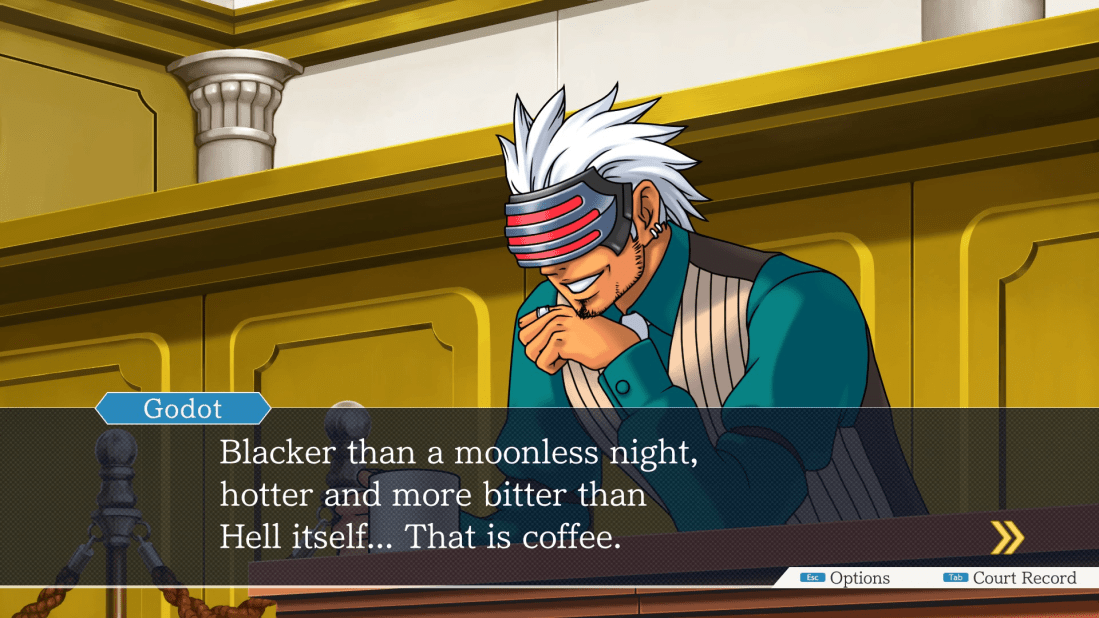
The other key antagonist (though far from a villain) is Prosecutor Godot. Each game in the franchise has a rival prosecutor, usually with their own personal connection. Prosecutor Godot starts off as a total unknown. Despite this, he despises Phoenix Wright with a fiery passion. His appearance adds to the mystery, with him wearing a robotic mask with three red lights which covers the top half of his face. Who is this coffee-chugging jerk, and how does this all connect?

One of my favorite elements of Ace Attorney is the expressive animations for the characters. Part of the fun of proving someone wrong for the first time is seeing their exaggerated reactions. Godot has many classics, with some unknown person sliding a cup of coffee down his bench like he’s in a game of Tapper. He’ll even chug a glass now and then just to do a spit take. Many visual novels settle for stationary sprites, yet Ace Attorney puts in enough effort that the designs themselves are a large part of the draw. The finale of the game’s devastating fourth case would have lost a lot of its punch without these evocative images.

The series effortlessly juggles a few atmospheres. The first case stands out because the outcome is obvious; there wouldn’t be an Ace Attorney series if Phoenix Wright was found guilty. Thus, it’s a rather lighthearted experience where we get to see the generally serious protagonist as a love-struck young man. But most villains in this series disappear immediately, yet Dahlia casts a wide shadow over the following events. The middle cases are more straightforward in their goofiness, which feels necessary as they lead into a rather dire finale. This could be a bleak criminal procedural throughout, but it’s those moments of humor and humanity that give Ace Attorney its undeniable charm.

The gameplay operates more as a logic puzzle than a series of button inputs, but anyone who criticizes this experience for not being enough of a video game is speaking nonsense. This experience would not work in another medium – no one who watches a let’s play will understand the thrill of finally connecting the pieces of evidence. During the trials, the player must sift through testimonies and point out where statements are contradicted by evidence; sometimes, the player must press for more information before the witness slips up. It’s that ‘a-ha’ moment where Wright shouts “OBJECTION!” which really drives this series.

To really highlight these moments beyond the killer reaction sprites, this series consistently has phenomenal soundtracks. The cross examination music carries an introspective ambience, while the music which plays during a successful objection really gets the blood pumping. These central themes have a few variations, getting more frantic as Wright gets closer to the final truth. The real highlight in Trials and Tribulations is Godot’s jazzy theme, “The Fragrance of Dark Coffee.” The prosecutors are great antagonists because they always act so smug – part of the fun in being right is wiping the smiles off their faces. When you first encounter Godot, this piece helps exaggerate his overconfidence. What’s truly wonderful about “The Fragrance of Dark Coffee” is how absolutely somber it becomes once you truly understand his character.

The Ace Attorney series helped to showcase that mysteries are one of video gaming’s strongest suits. The fact it has been successfully imitated in the tonally-distinct Danganronpa series shows this was more than a few lucky elements coming together. Ace Attorney paved the way, and hopefully more developers will push the genre in new directions. Outside of horror, no other narrative genre is improved quite as much by putting the audience in the central role. Few mysteries have ever hit the raw emotional depths of Trials and Tribulations.

The Greatest Games: Final Fantasy VII (1997)

Final Fantasy VII (1997)
Developed by Square

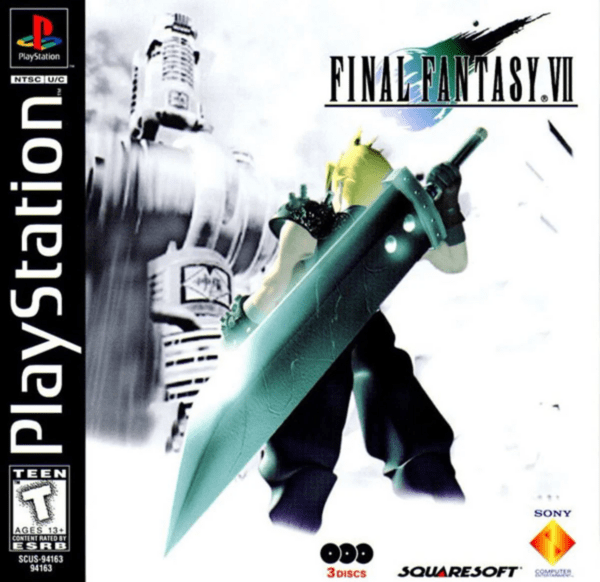
As someone who largely experienced 90s video games as a teenager in the mid-2000s, the overwhelming popularity of Final Fantasy VII has always been a bit jarring. The reasons for its commercial success are largely nonsensical now; this was seen as an example of cutting edge technology? But what gets people to pick something up in the first place can differ from what sticks with them. Square sold this game based on cutscenes which looked much better than the standard gameplay, but people who bought in were rewarded with the latest iteration of a solid franchise that had been largely overlooked during the previous generation.

Square simply does memorable characters better than most companies. While plenty of games feature deeper protagonists with stronger characterization, that quality rarely extends to the supporting cast. With Tetsuya Nomura’s distinctive designs, each individual party member has become a video game icon. One of Final Fantasy’s greatest strengths is its Seven Samurai-styled collection of disparate heroes coming together for a shared cause, and VII is absolutely the most consistent cast in the series. Even relatively minor characters like Zack Fair and Rufus Shinra have captured the imagination.

Final Fantasy VII truly outshines its legacy. Cloud Strife is absolutely deserving of his place as one of the definitive video game protagonists. Square themselves seems to have lost track of what made him special, framing him as the quiet brooding type in later appearances like Kingdom Hearts. The whole point of his actual character arc is that Cloud is deeply disturbed and has been clinging onto a personality which is not his own. One of the game’s defining moments has Cloud break out of this shell and become his true, more joyous self.

What makes this change special is how it affects our understanding of the cast itself. Cloud is caught inside gaming’s most famous love triangle, which is already complicated by one of the participants being the victim of gaming’s most well-known spoiler. But with this twist comes the realization that Aerith is drawn to the performance while Tifa has been longing for the real Cloud.

The surprise of FF7 is how it wades through some complex territory. Ecoterrorism, corporations killing the planet, identity, betrayal, death – this features some heavy stuff compared to most mainstream hits, and it seems that later entries were wary of tackling anything too controversial once 7 shot the series into the spotlight.

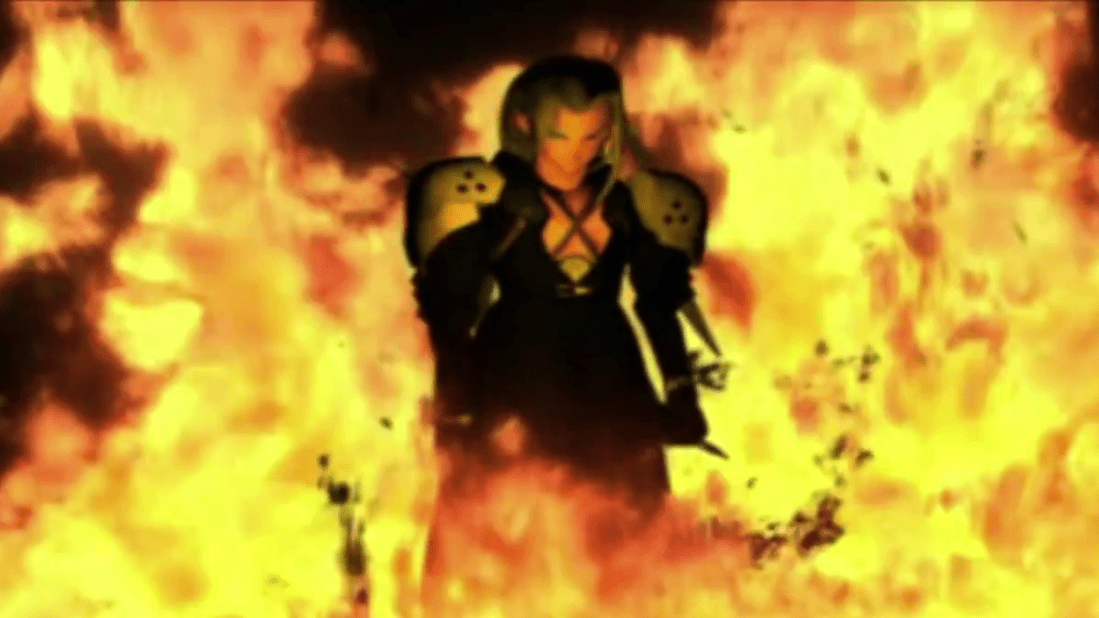
So many of these moments are magical. Stepping onto the world map for the first time, Sephiroth standing amidst the flames, that famous twist at the end of disc one – Square knew how to direct our attention. The standard presentation would have never been enough for this ambitious story, so the cutscenes really do assist in generating emotional resonance.

But the highlight of the presentation has always been the score. Nobuo Uematsu is the biggest name in video game music for a reason, and everything about Final Fantasy VII’s soundtrack is phenomenal. Beyond the simple beauty of the music, Uematsu expertly links many of these songs together through distinct motifs. Even as the party strays far from where they began, these motifs are a constant reminder of everything being connected.

What made Final Fantasy such a definitive JRPG experience between the SNES and PS2 eras was the way each game offered its own unique spin on a sturdy foundation. While VII stands as the most popular, they are each of a distinct quality where any individual entry would be a reasonable favorite (except perhaps VIII). The Materia system does a fantastic job of giving the player control over what their characters can do. The fact there are many powerful Materia throughout the world also makes it essential not just to level but to hunt these items down – any JRPG that gives a meaningful way to power up outside of shopping and grinding has a distinct advantage.

The hunt for these Materia also highlights the size of this world. There are so many sidequests and secret bosses. Yet even while restrained to Midgar, this world feels huge. There’s always some new corner to explore, and the game offers some serious rewards, including two full-fledged party members.

I’ll never quite have the nostalgic association with FF7 like those who got to experience it upon release. Even then, the core experience stands strong – turn-based gameplay never really ages and the narrative concepts have remained unique. There’s a reason everyone had been clamoring for a remake – the graphics have always been the sole barrier for new players from an otherwise flawless game. But with Square deciding to experiment with the remake, the original remains a distinct and definitive experience.

The Greatest Games: Gunstar Heroes (1993)

Gunstar Heroes (1993)
Developed by Treasure

Treasure is one of gaming’s hidden gems, a company which pushed stylistic boundaries while largely refusing to capitulate to the industry’s demands for sequel after sequel. Their focus on unique IPs gave them freedom to experiment without solidified expectations, and their output like Ikaruga and Sin & Punishment stand among gaming’s most singular experiences. This all began with Gunstar Heroes, a run and gun shooter that pushed the Genesis to its chaotic limit.

Like most games in this genre, Gunstar Heroes is largely simple to play. In the beginning, you choose between four basic weapon types. What makes this special is that the characters have two weapon slots, and these two slots can be combined to make a specialized attack. With 4 basic attacks and 10 combined variations, there are simply a ton of options in a genre where many games stick to the basics.

The four basics have their own specialties: force has rapid fire, lightning offers a long-range piercing attack, chaser homes, and flame is strong but short-ranged. The combinations logically combine the two concepts, with two of the same weapon simply offering a stronger variant. So, lightning and fire make a short-range mega weapon, while lightning and chaser can shift the player’s focus to movement while the weapon automatically and slowly chips away at enemies. A key feature in the initial options screen is the ability to choose between free or fixed controls. Free allows the player to move and shoot while fixed stops the character while firing but allows more directional control with aiming. Certain combinations work better depending on the control scheme.

The inclusion of cooperative gameplay is also a boon. It’s always fun to let a friend join in, but this particular game benefits from two players meaning two different weapons. Really, one thing I’ve always missed from this era is the rather common implementation of co-op. Whether it’s something as simple as controlling Tails or being able to play the full game on equal terms as in Gunstar Heroes, I sometimes find myself going back to this era because so few modern games even attempt to replicate the experience. With chaos being one of Treasure’s central tenets, a second player only builds upon the madness of Gunstar Heroes.

Gunstar Heroes is one of those classic ‘easy to learn, hard to master’ games. Playing is as simple as holding the shoot button and moving. But as the game throws out more and more enemies, your focus will turn more to the layout of the stages; how do you use these mechanics within this location?  The challenge is less about hitting the enemy than maintaining your health throughout these massive stages. The central bosses all push the limits, especially on the harder difficulties.

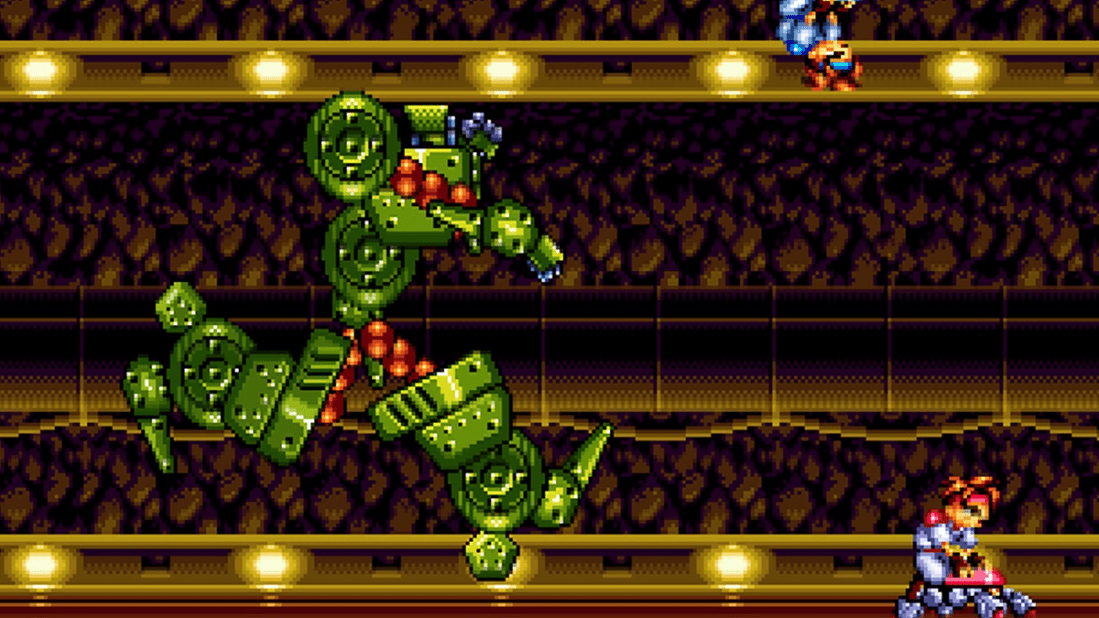
Seven Force is among the most striking boss fights I’ve encountered. Tucked away in only the second of seven levels (though you can and probably should play the first four levels in a different order), this boss goes through either five or seven distinct forms depending on difficulty. Each of these forms have as much health as a full boss, so the entire fight becomes an endurance run of mastering his simple yet changing mechanics. This is one of gaming’s best brutal yet rewarding experiences; he is fully manageable once you get the game down pat, but getting there seems impossible at first glance. Adding to the experience is the detailed design, with each section of Seven Force’s several bodies being animated as distinct pieces. Gunstar Heroes is absolutely one of the best looking games of the fourth generation, and that is on full display during this fight.

While games like Contra have been around forever, Gunstar Heroes went above and beyond. Mixing smooth yet variable gameplay with challenging designs and a vibrant style, Treasure created a chaotic classic. This is the run and gun genre perfected; no other even comes close.

The Greatest Games: Zero Escape: Virtue’s Last Reward (2012)

Zero Escape: Virtue’s Last Reward (2012)
Developed by Chunsoft

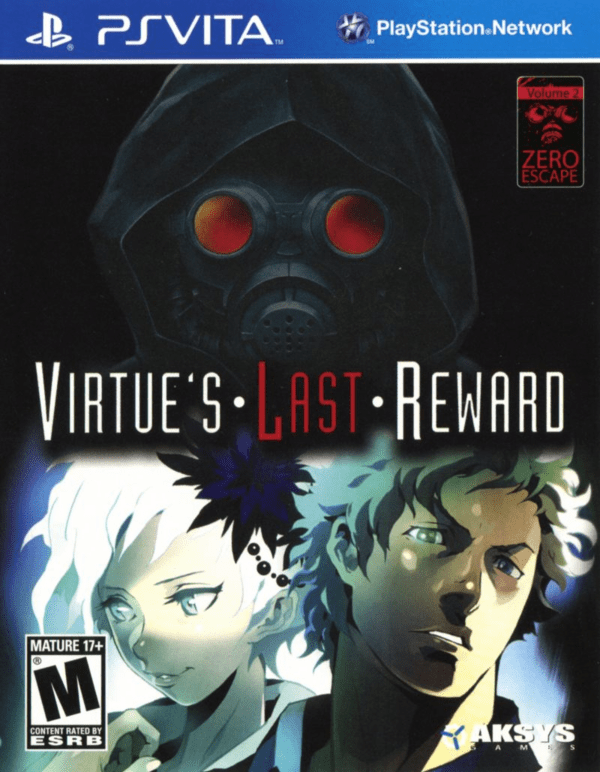
General spoiler warning: Virtue’s Last Reward is the sequel to 999; the central concept of VLR is built around the plot twist of the first game. Since I cannot discuss any meaningful element of VLR without bringing up that twist, be warned that this will be spoiling that earlier game. (Surprisingly, I’ve managed to avoid meaningful spoilers for VLR itself – which, being a visual novel I can praise without narrative spoilers should itself be taken as a sign of its quality)

Nine Hours, Nine Persons, Nine Doors started off with a killer concept and transcended to something else entirely with the revelation that the whole thing was a psychic experiment drawing information from alternate realities. The problem with this system was that only two of the paths really mattered, and they had to be completed in a specific order to reach the true ending. By acknowledging this concept from the beginning, Virtue’s Last Reward is better able to implement mechanics to make these various realities connected.

The big thing here is the inclusion of a flowchart which fills in as you stray down the various paths. The player can jump to key moments – the first game required starting from the beginning each time, which could get rather tedious even with a skip dialogue feature. Additionally, the puzzles down each path are completely unique. Where 999 had only two meaningful endings, VLR hides secrets down several paths. Basically, it’s a total overhaul of the first game, to the point that rereleases of 999 now include their own flowchart. It’s hard to explain the joy of experiencing a story with multiple canon endings.

By making each path count, there’s simply more time to make all these concepts and characters matter. Each of the nine characters, including the protagonist, are harboring some major secrets. No one is here just to spout off psychological concepts and game theory – they certainly still do that, but there’s a lot more going on as well. Which path you take first can completely change your perception of other routes; no two players will really experience the same narrative until it’s all tied together at the end.

Another key change is the addition of meaningful decisions. In 999, all you really had was which door to choose and making sure to hear a few important conversations. In addition to the doors, the characters of VLR are constantly forced into a game implementing the Prisoner’s Dilemma. Each character starts with three points, and they will be released if they manage to score nine – whoever escapes first will seal everyone else inside. If their score hits zero, they are immediately executed. If they choose to ‘ally’ with each other, those involved gain two points. Both betraying results in no change, while being betrayed results in losing points while the traitor gains more. This gives the player more meaningful influence over the paths while also providing a better read on what these other characters represent. Who appears too trusting, and who will predictably stab everyone in the back? The game makes sure to play a few neat tricks here and there, just to keep the player alert.

The escape room segments continue to be a fun way to break up the tedium and stop this from being a traditional visual novel. They also help add to the Saw-inspired atmosphere. Most come for the story, but simply having the player actually interact with these puzzles is a convincing method to get inside the head of the protagonist. Otherwise, he would simply be a character you sometimes command, which can shatter the illusion of player-protagonist connection. This game wouldn’t work if you didn’t feel personally betrayed by these characters at key moments. This feeling is emphasized by the Prisoner’s Dilemma segments occurring between those who solved these rooms together.

I’d prefer not to dive into any more details – this is simply a brilliant narrative structure with tons of effective twists. The entire Zero Escape series feels like a key example of how video games can tell narratives in a way other mediums cannot, and Virtue’s Last Reward is the highlight.

The Greatest Games: Kingdom Hearts II (2006)

Kingdom Hearts II (2006)
Developed by Square Enix Product Development Division 1

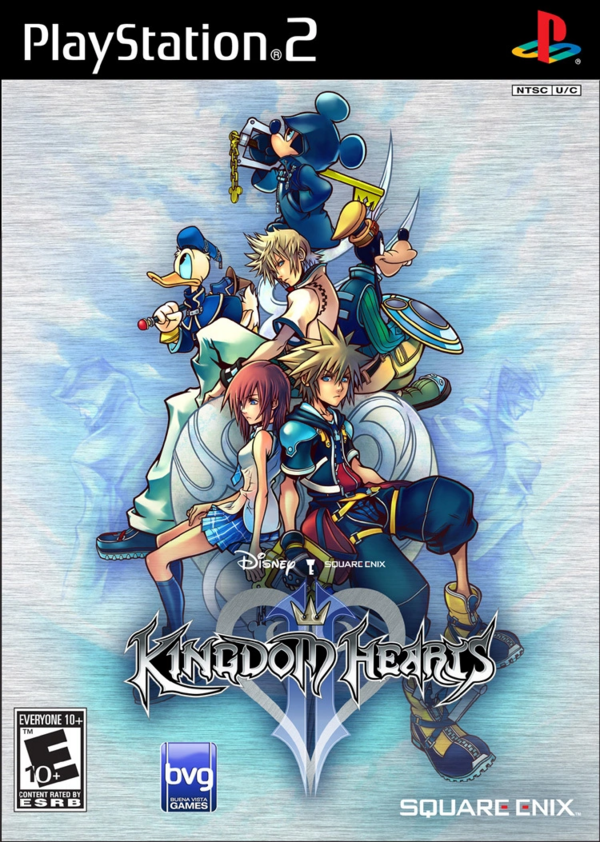
From the beginning, Kingdom Hearts was one of those ideas which should have never worked. Even its creation seems improbable, starting as a literal elevator pitch as someone from Square Enix ran into a Disney exec on an elevator. The colorful world of Disney mixed together with the stylish Final Fantasy series seems like something which should appeal to exactly no one, yet it’s become one of the most popular JRPG franchises. The fact it took that odd creation as a jumping point to become one of gaming’s most convoluted narratives is both asinine and completely on-brand. Even several games in, I can’t help giggling as Donald Duck talks about ‘the darkness.’

But few songs hit my nostalgia like “Dearly Beloved.” Kingdom Hearts is nonsense, but it’s my nonsense. II stands high above the rest, fixing the clunky feeling from the original and, well, not being the later games. This game helped mark a huge shift in action gameplay alongside Devil May Cry 3 and the original God of War; graphics have advanced considerably, but the gameplay of these games are as smooth as ever.

The original Kingdom Hearts played a bit safe with its Disney choices. The only real surprise was The Nightmare Before Christmas, which had more to do with Disney otherwise keeping it away from their other animated properties. Everything else shared a generally colorful aesthetic. Kingdom Hearts II switches things up with Timeless River (designed to simulate the black-and-white Mickey Mouse cartoons) and Space Paranoids (which captures the neon cyberpunk style of the original Tron). Even the more obvious inclusion of The Lion King involves transforming Sora into a lion cub, which puts a fun spin on the combat. There’s also the more, uh, realistic Pirates of the Caribbean level, which might be a weak point but reinforces that each of these levels really capture their own unique traits.

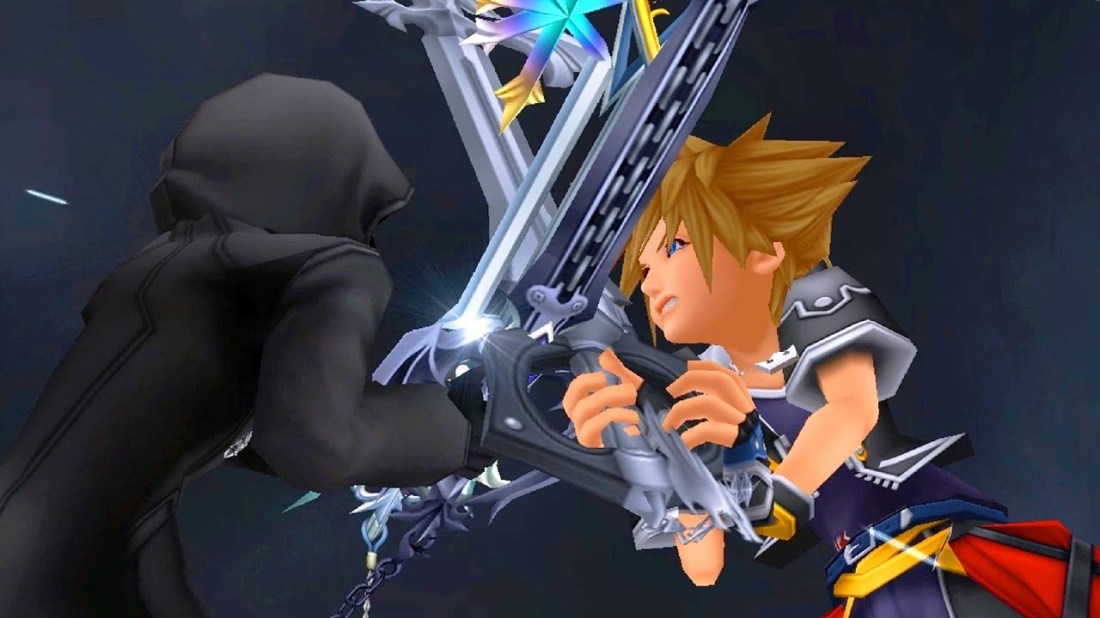
Combat in the original was fun if a little basic. II maintains the simple feel while adding a few more options, the most central being the drive forms and reaction commands. The drive forms give Sora distinct boosts and unique traits. These are integrated well, as you can eventually unlock permanent upgrades for Sora through levelling these forms. They all level using different mechanics, which gives a reason to keep using each of them. This carries its own risk, as overuse can transform Sora into the Anti Form, where he loses most of his abilities but gains incredible speed.

Reaction commands break up the tedium of hitting the same button over and over. Certain moments in battle will reveal an enemy’s weak point, which can be engaged with through a separate button press. This may not sound like much, but gameplay is the one element this series was smart enough to keep simple. It’s just enough to make things more exciting.

The boss battles are a real highlight. Though I still don’t quite get Organization XIII on a narrative level, more humanoid bosses tend to be more engaging, and their presence offers a hefty amount. The Final Mix takes this further by offering even more difficult versions of each member, including those not actually present in the central narrative. What makes humanoid bosses great in action games is that those which are well-designed feel like a battle on even ground, even as the boss pulls off impossible feats. With so much fun content in the Final Mix, Kingdom Hearts II is one of the few RPGs which gives a compelling reason to grind for end game content.

While the opening hours can be a bit tedious after the first playthrough, Roxas’s story is a strangely resonant microcosm of the series’ themes. Having still not played Chain of Memories, I’m certain there are bits I’m missing, but “Looks like my summer vacation is over” still hit me like a brick the first time through. I think that’s the defining feature of Kingdom Hearts as a narrative – even if you don’t fully understand the overarching plot, it still manages to find the emotional core through the experiences of the characters.

Kingdom Hearts II takes the best of the RPG and Action genres, creating one of the most vibrant series in gaming. While its story may not be for everyone, it’s a rare RPG where the narrative might be its weakest hook. In fact, the individual moments count for more than the narrative at large – in a series where visiting Disney worlds started as the main selling point, Kingdom Hearts II simply has the best of the bunch. Over a decade later, this is still a blast to play.

The Greatest Games: Super Mario World (1991)

Super Mario World (1991)
Developed by Nintendo EAD

The secret of this writing project is that, despite being perhaps the most famous video game series, Mario is absolutely proving to be the hardest thing for me to write about in this context. What is there to say about Super Mario World which hasn’t already been said about Super Mario Bros. 3 or the other platformers which expanded upon this formula? I can’t even say it took SMB3 and did it better, as there’s been times where I preferred the older game. It’s like trying to define the word ‘the,’ something so foundational that describing it requires more technical knowledge than simply using it.

To put this another way – critics like video games with stories because it gives them something easy to write about.

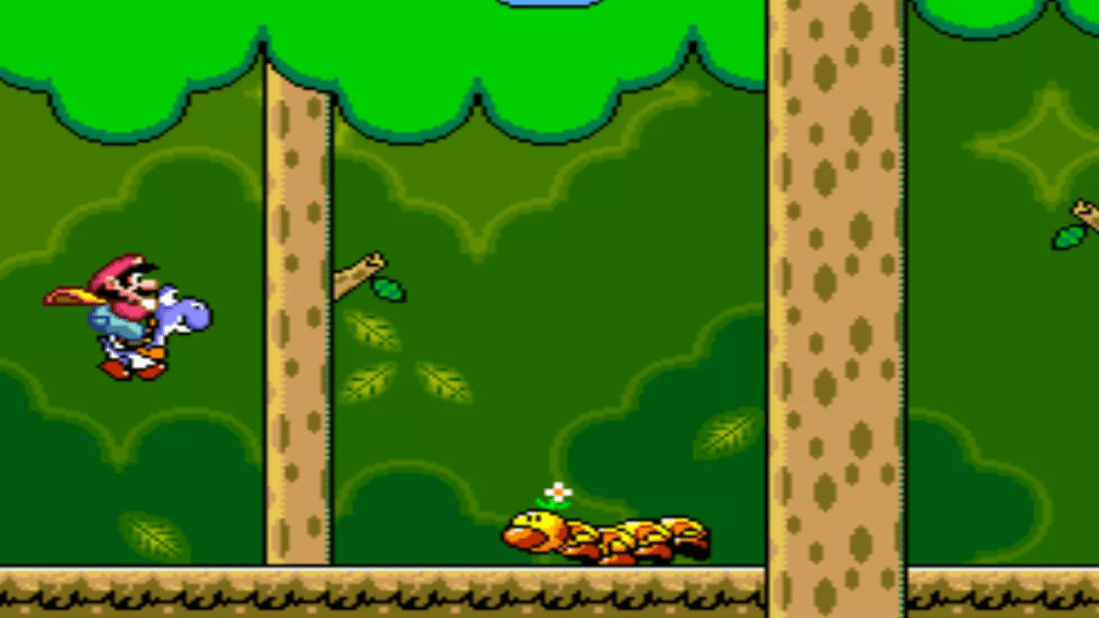
So let’s try to get technical. I’ve played plenty of platformers in my life; what is the specific element which sets Mario apart? For me, Mario simply controls better. It’s surprising how many platformers out there never end up feeling quite right. The ease of adjusting Mario’s movement as he jumps gives the player a perfect sense of control. Many other platformers introduce weapons or more realistic momentum. Mario keeps things so simple that platforming and fighting are one and the same. But it’s not as easy as reducing all enemies to jump damage. I just played through Sonic 3 & Knuckles, which shares a similar design philosophy, except there are times when jumping will not do damage – you have to jump in a specific way or else the character does not enter the necessary ball form. Other platformers are too floaty, which feels unnatural and reduces the urgency which typically makes the genre engaging. When a platformer’s controls gets too complex, it can sometimes feel as though the game is not properly responding to certain inputs.

The 2D Mario games always managed to avoid that feeling. It’s all about jumping, with the only real complexity coming from its intuitive button mechanics. Mario will jump higher if you hold the button down longer. Most platformers incorporate this mechanic, but Mario’s singular focus means the stages are constantly building upon this one mechanic. World introduces an alternative jumping attack, but this is importantly assigned its own button. There’s just enough depth, but each element is intuitive. We can talk about level design, but even the most basic levels work because these mechanics provide such a solid foundation.

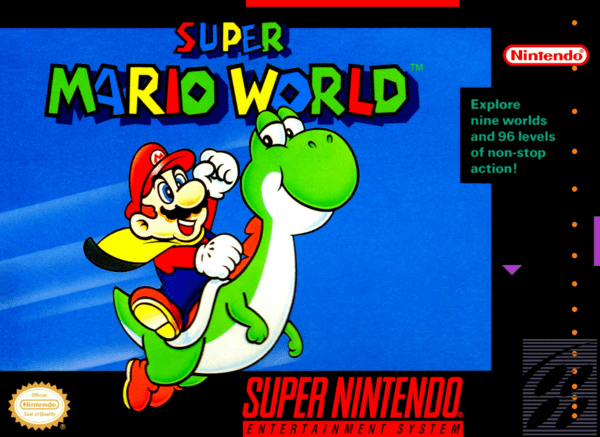
Yoshi was a key addition to the series. Mario’s lovable dinosaur pal changed up the basic mechanics, but again in an intuitive way. His presence offers some nice variety and helps Mario access distant paths. This also leads to a particularly uncharacteristic bit of dark humor on Nintendo’s part. One level requires Mario to ditch Yoshi to make an otherwise impossible jump. His sacrifice will never be forgotten.

With steadily increasing difficulty built around these mechanics, the levels are all expertly crafted. There are also a significant amount of secret levels and alternative paths which reward exploration in a largely straightforward genre. Getting to the final level doesn’t take too long, but the game has so much to offer. With such fluid mechanics, more levels is always better, especially when several of those bonus levels require absolute mastery of these controls.

In video games, Mario’s influence is ubiquitous. When discussing platformers, the easiest option is to note how it differentiates itself from this franchise. Sometimes, these added layers can make Mario seem too simple in comparison. But it’s not simple due to neglect – this simplicity has always been an informed creative decision. Nintendo has done their best to ensure all their major franchises remain mechanically accessible while lending themselves to distinct level designs – the later success of Super Mario Maker reveals how endlessly variable this system can be. Super Mario World just happens to be the 2D Mario formula at its arguable best.

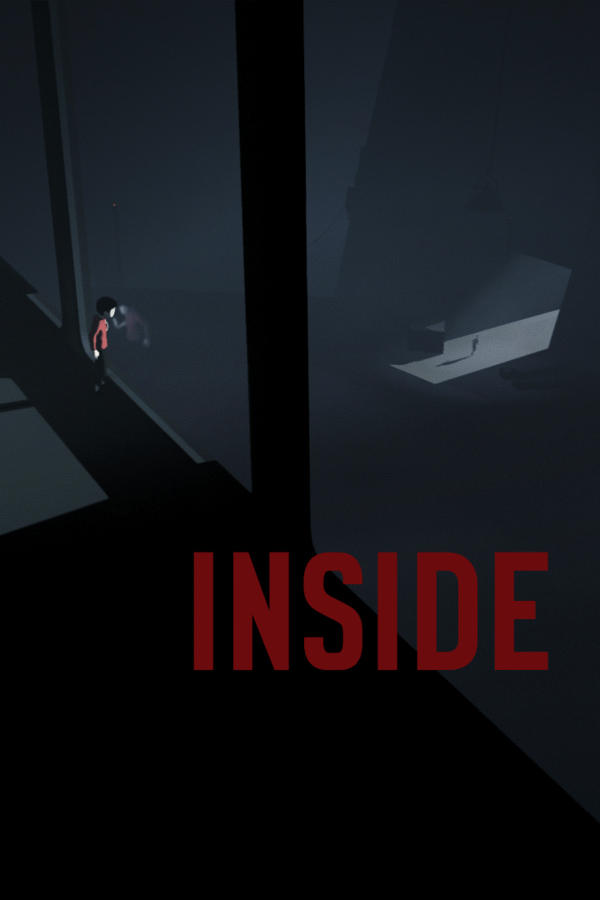
The Greatest Games: INSIDE (2016)

Inside (2016)
Developed by Playdead

INSIDE is a masterpiece of surrealist horror seamlessly integrated with truly ingenious level design. Each area introduces an unforgettable concept, both stylistically and in its handling of platformer-based puzzles. Though the game can be completed in a single sitting, each second will make your skin crawl.

What makes this so effective is that INSIDE never stops to clarify its events. The game begins with a boy fleeing armed guards. This suggests a basic story of survival in a dystopic setting. There’s only one problem. This boy is not escaping. As the title suggests, you quickly realize he’s heading deeper inside this monstrous facility. With every door revealing a greater horror, you’re left begging for answers. None of these rooms quite connect to one another. And when the game finally delivers an answer, things only get worse from there.

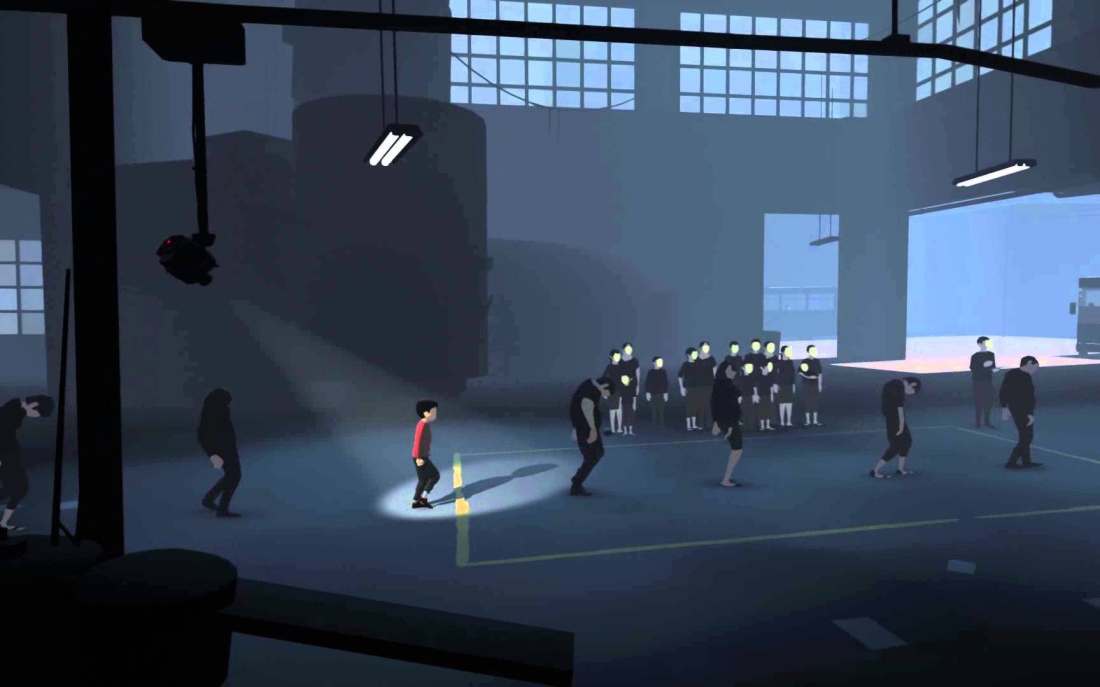
INSIDE, like Limbo before it, has a very simple art style. The protagonist even lacks a face. One might wonder how this can cause such effective horror, but the simplicity allows the developers to get away with some truly grotesque violence. You do not want to die in this game. Not only because it means going back to the last checkpoint, but because the death scenes are legitimately distressing. Whether he’s being ripped apart by guard dogs or shredded by a propeller, the little details they put in are nauseating. This reinforces the central question; why would anyone put themselves through this danger?

This is the part where I suggest turning back if you want to avoid meaningful spoilers. Because this game is built around constant atmospheric shifts, discussing any level in detail beyond the first without spoiling any surprise borders on impossible, but I would also be doing this game a disservice by limiting myself to surface observations. Even then, words cannot capture the presentation of these moments; this is truly a game which needs to be experienced, blind if possible.

After being chased through the countryside, the boy arrives in a city where people shamble in file like a pack of zombies. The boy is forced to join this line, keeping pace in hopes the guards don’t notice something off. As they get further in, the people start doing certain actions which the player must follow. This methodical moment is already tense, and the game will likely earn a deserved kill when you inevitably freeze up after finally being discovered. There are no rules to this game beyond survival, and the key is recognizing when the primary threat changes.

The one room I’ll never recover from is the shockwave chamber. After spending most of the early parts of this game avoiding enemies, the boy finally comes across an empty room. Every few seconds, a shockwave pulses through the entire area. If you do not have cover, you will instantly be blown apart. This starts simple enough, requiring the player to dodge between obvious safe points. But later cover includes moving machinery, some of which moves much quicker than the player. The level becomes a horrifying timing puzzle, requiring you to find the exact moment for temporary cover. It’s terrifying and oppressive and I never felt a greater sense of relief than when I finished this nightmare.

This is followed by a flooded chamber, where the boy enters a small sub and must avoid long-haired girls who will quickly break through the glass and drown him. They can be scared off by light, which requires a fine balance between forward movement and paying them attention. Again, these levels work due to the lack of information. What, exactly, are these girls? It doesn’t matter – what does matter is that whoever is behind this facility has unleashed all of our worst nightmares.

And then there’s the finale, which is the one part I should really emphasize not reading about if you’re unfamiliar. At the same time, I was actually exposed to the finale without context and did not realize until I reached the ending – that’s how off the rails INSIDE can get.

During the final moments of this game, the boy swims inside a vat and releases a gigantic writhing mass of human bodies which quickly consumes him. And then you begin controlling that mass. The final level feels like playing as Spirited Away’s No-Face as he rampages through the bathhouse, with the gathered scientists fleeing in terror as the mass mows them down. More than ever, you have absolutely no idea why you’re doing this. The mass eventually breaks outside, tumbles down a hill – and then it’s over.

It takes a second for the pieces to click. This actually is a game about escaping, but not in a way anyone would have imagined. You were not helping this boy survive. Rather, in a game with constant elements of mind control, you were the pawn of a psychic eldritch abomination. Many cosmic horror stories feature characters being tricked into helping Ancient Ones. INSIDE succeeds in making you play that role, putting yourself and the poor boy through a horrifying ordeal in the name of assisting something which has no right to exist. Unlike other games which force the player into a moral dilemma, INSIDE does not reveal you’re doing something wrong until it’s too late.

INSIDE is as tightly-focused as video games come, telling a riveting narrative purely through environmental storytelling while packing unforgettable level design.