The Greatest Games: Paper Mario: The Thousand-Year Door (2004)

Paper Mario: The Thousand-Year Door (2004)
Developed by Intelligent Systems

I realized after starting this project that writing about the Paper Mario games would be among the hardest. Having not played either game in over a decade now, certain elements have blurred together. Add in that The Thousand-Year Door is a sequel in the most traditional sense, and how do I say enough about both without repeating myself?

There are other series with multiple entries, but most have distinct enough features that I can really hone in on those specific quirks. The Thousand-Year Door is Paper Mario but bigger and better, but not in a way which makes the predecessor obsolete. Unlike comparing Left 4 Dead to its sequel, Paper Mario and The Thousand-Year Door remain distinct experiences due to features typical of the JRPG franchise. They have their own sets of characters and stories, with both having great writing. The real sticking point for both deserving their place on this list is that Paper Mario’s charm is in its simplicity; TTYD making things even slightly more complex means certain people will prefer the original.

The two chapters from The Thousand-Year Door which have stuck with me the most come from opposite ends of the spectrum. Both highlight distinct traits that make the Paper Mario series so good. The first is chapter 3, which features Mario fighting his way through a series of arena battles. Where most Paper Mario chapters are full of areas to explore, the Glitz Pit remains focused on combat. There are a ton of battles to fight through, and each comes with their own stipulation which limits your options. This can really force the player to change up their strategy. Champion Rawk Hawk is one of the more memorable characters in the series, his narcissistic attitude perfect encouragement to climb the ranks and beat him down.

Chapter 6, on the other hand, is all about Paper Mario’s humorous sense of storytelling. Mario finds himself on a train with a bunch of odd passengers and eventually gets caught up in a series of mysteries. This pseudo-Christie narrative gives the writers a perfect opportunity to go crazy. An encounter involving a ghost’s diary plays an especially fun trick on the curious.

Changes to the battle system help make the partners feel more distinct. TTYD gives partners their own HP value, making them feel more like traditional party members. The game also introduces an audience who have various interactions throughout the game. These changes aren’t huge, but that’s key to the signature simplicity.

Like its predecessor, TTYD cuts away to Princess Peach. Getting to actually know the princess rarely happens in the main series, and she is a lot of fun here. We also get a few moments to play as Bowser in classic Mario inspired levels.

There’s not much more to say about The Thousand-Year Door in comparison to the original. The first Paper Mario is a short and simple JRPG, a genre which usually goes for complexity and epic quests. The Thousand-Year Door is more of this, but where everything feels slightly improved. The Mario series has tons of spin-offs, but few feel as key to its grander identity due to the charming handling of its universe.
The Greatest Games: Paper Mario (2001)

Paper Mario (2001)
Developed by Intelligent Systems

The Mario series has always been a stylistic oddball, a remnant from an era where character design had more to do with what could pass with limited technology than any semblance of narrative purpose. A plumber fighting a dragon-turtle to rescue a princess is the exact sort of nonsense we’ll accept in an NES platformer without question, because why would we care?

I bring this up because the Mario RPGs were handed the challenge of making some narrative sense of this nonsense. Instead of playing things as simple as the platformers, SMRPG and the Paper Mario games really go all-in on this strange setting, adding a layer of whimsical humor through excellent characterization and then ramping it up through its own bizarre creations. This is where most of the central cast really comes into their own, with special sections focused on Peach really adding to her character. The universe starts to feel like more than a dozen stray thoughts smashed together – or rather, it continues to feel that way, but with purpose!

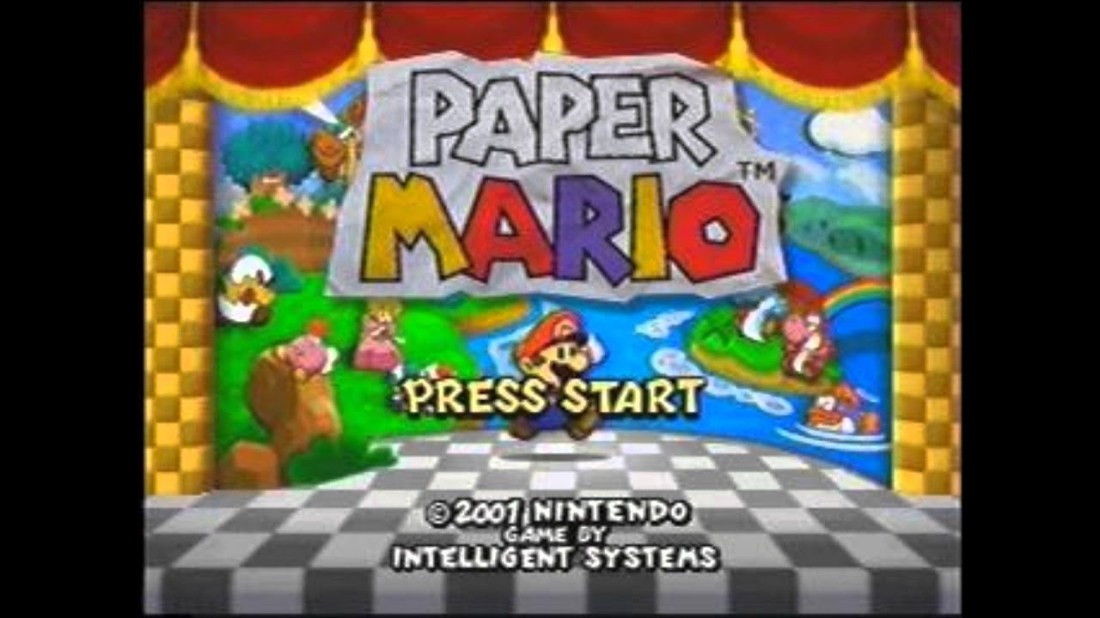
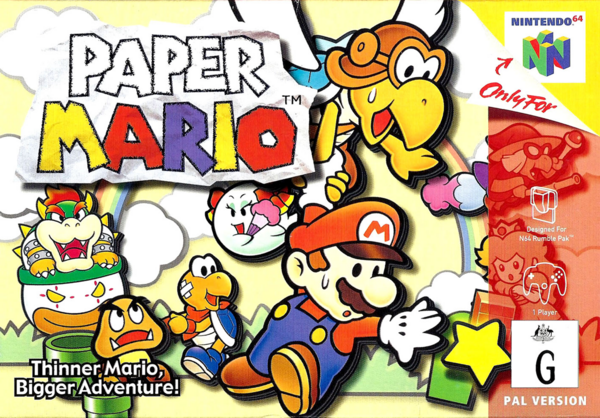
The fifth generation of console gaming is perhaps the toughest to revisit. Even through the early PS2 era, capturing a sense of fluid motion in 3D gameplay proved challenging for many developers. Most games from this generation simply do not look very good. Nintendo, however, has always had a knack for making limited technology work in their favor. Through its combination of 2D characters and a storybook-styled world, Paper Mario might just be the best looking game from its era. There’s a simple charm about its aesthetics that work even twenty years later.

Paper Mario has the magical feeling of being a beginner-level RPG while offering enough to remain engaging to even the most experienced player. The use of timing mechanics during combat offers a better experience than simply mashing attack until the enemies are defeated like many other JRPGs – all while serving as a reminder that this is a Mario game, where timing your jumps as you land on enemies has always been key. Most enemies having certain weaknesses or immunities also adds at least some thought to basic encounters. Though the game might be overly easy, it never stops being fun. The simplicity of its numbers is also important here, allowing the player to better understand just how much damage they’re doing without much analysis required; these low numbers also keep the battles at a quick pace.

Even if the overarching narrative is simple, with Bowser again kidnapping Peach, there’s so much charm in each of this game’s locations and the characters within. Generic enemies from earlier games are given a chance to shine, and the subplots offer up their own whimsical moments.

Simple is a word I keep coming back to, but I think that’s what really sets Paper Mario apart; this is a minimalist RPG that does everything just right. There’s really not all that much to it, but the presentation is just that strong – and considering how many contemporary JRPGs really came down to rudimentary attacks in everything but boss battles, the lack of complexity does little to hurt. Ultimately, Paper Mario improves what Super Mario RPG started, a comedic RPG that still manages to capture the spirit of a classic Mario game.